
AI Worship Song Generator: Write Scripture-Rich, Singable Worship Lyrics
An AI worship song generator turns a prayer, a Bible verse, or a Sunday theme into a starting draft of worship lyrics — verses, a chorus, and a bridge you can shape into something your church can actually sing. Built for lyrics rather than audio, an ai song writer like Lyrivo works alongside you as you write, and this guide shows how to write worship words that are scripturally grounded, congregationally singable, and unmistakably yours, in the tradition of contemporary worship music.

Worship songwriting is a craft with its own rules — vertical and horizontal focus, congregational singability, and honest attribution when you lean on Scripture or existing hymns. Use AI as a co-writer for the blank page, then bring your own theology, discernment, and heart to the final lyric. The same approach works whether you’re writing for a Sunday set, a themed sermon series, or a seasonal moment like Advent or Easter.
What an AI Worship Song Generator Actually Does
«AI worship song generator» covers two very different kinds of tools, and mixing them up leads to the wrong expectations. Whether you search for an AI hymn generator, an AI gospel song generator, or a praise and worship song maker, most results fall into one of the two categories below — and the difference matters more than the label.
Lyrics-first vs. audio-first tools
Some tools generate a finished track — music plus AI vocals — in a few minutes, producing a full song you could play in a service without touching an instrument. Others work purely with words: verse, chorus, and bridge lines, rhyme, imagery, and a hook, meant to be sung by a live worship team or handed off to an audio engine afterward. An early example, worship.ai, built by developer John Dyer on a markov-chain script, produced novelty text loosely styled after psalms and hymns rather than a usable lyric. Lyrivo and similar worship song lyrics generators sit in the lyrics-first camp, and the same approach applies whether the target style leans toward contemporary worship or gospel music. That distinction matters: the words are what a congregation actually memorizes and confesses together, long after the backing track is forgotten.
| Approach | What it produces | Best for | Example category |
|---|---|---|---|
| Lyrics-first assistant | Verse/chorus/bridge text, rhyme and hook options | Songwriters and worship teams shaping their own song | AI worship lyrics generator |
| Audio-first generator | A finished track with music and AI vocals | Quick demos or background tracks | AI worship song creator (audio) |
| Novelty text generator | Loosely styled psalm/hymn-like text | Experimentation, not final lyrics | Early markov-based tools |
Where AI helps most in worship writing
An AI worship song generator earns its place at the songwriting desk in a handful of specific spots, not as a replacement for the whole process:
- Breaking a blank page by drafting two or three opening verse options from a single line of Scripture
- Suggesting rhymes and near-rhymes for an awkward word that resists an easy match
- Rephrasing a clunky line so it fits the melody’s syllable count and stress pattern
- Generating chorus hook options built around one central declaration
- Offering bridge variations for the song’s emotional and theological high point
AI proposes; the writer decides. The theology, the honesty, and the heart behind the lyric stay with the human songwriter.
Is It OK to Use AI to Write Worship Songs?
Several worship-focused tools address this question head-on in their own marketing, which is telling — the makers of these generators are the first to say AI does not replace a live worship leader or a gathered congregation. That’s a healthy frame to borrow: the tool is neutral, the same way a rhyming dictionary, a hymnal, or a guitar is neutral. What makes a worship song holy isn’t the method used to draft it — it’s the truth and the intention behind the finished words.
God is spirit, and those who worship him must worship in spirit and truth.
John 4:24, ESV
Before a line generated with AI goes into a set list, run it through three quick checks: Is it biblically accurate? Is it genuinely yours, not a lift from an existing song? Can you sing it and mean every word? If any answer is no, the line needs more work regardless of who or what drafted it first.
Keep it your voice, keep it true
A short set of habits keeps AI-assisted worship writing honest:
- Pray over the theme before you start writing, and again after you have a draft
- Check every doctrinal line against Scripture rather than trusting it because it sounds right
- Never sing or publish a line you don’t personally understand
- Feed the AI your own material — your testimony, your chosen verse, your specific season — instead of asking it to «write a worship hit»
Scriptural and Theological Grounding
The strongest worship lyrics grow out of one specific passage, not a vague spiritual mood. Start by choosing an anchor verse — Psalm 96, which opens with «Sing to the Lord a new song» (NIV), is a classic model for a praise-focused song. Pull one image and one verb out of that passage, then ask the AI to build a verse around that image rather than replacing it with something generic. Worship-writing archetypes recur for a reason: grace and surrender, testimony and overcoming, or the shepherd imagery of Psalm 23 all give an AI worship song generator a concrete seed to work from instead of an abstract prompt like «write about God’s love.»
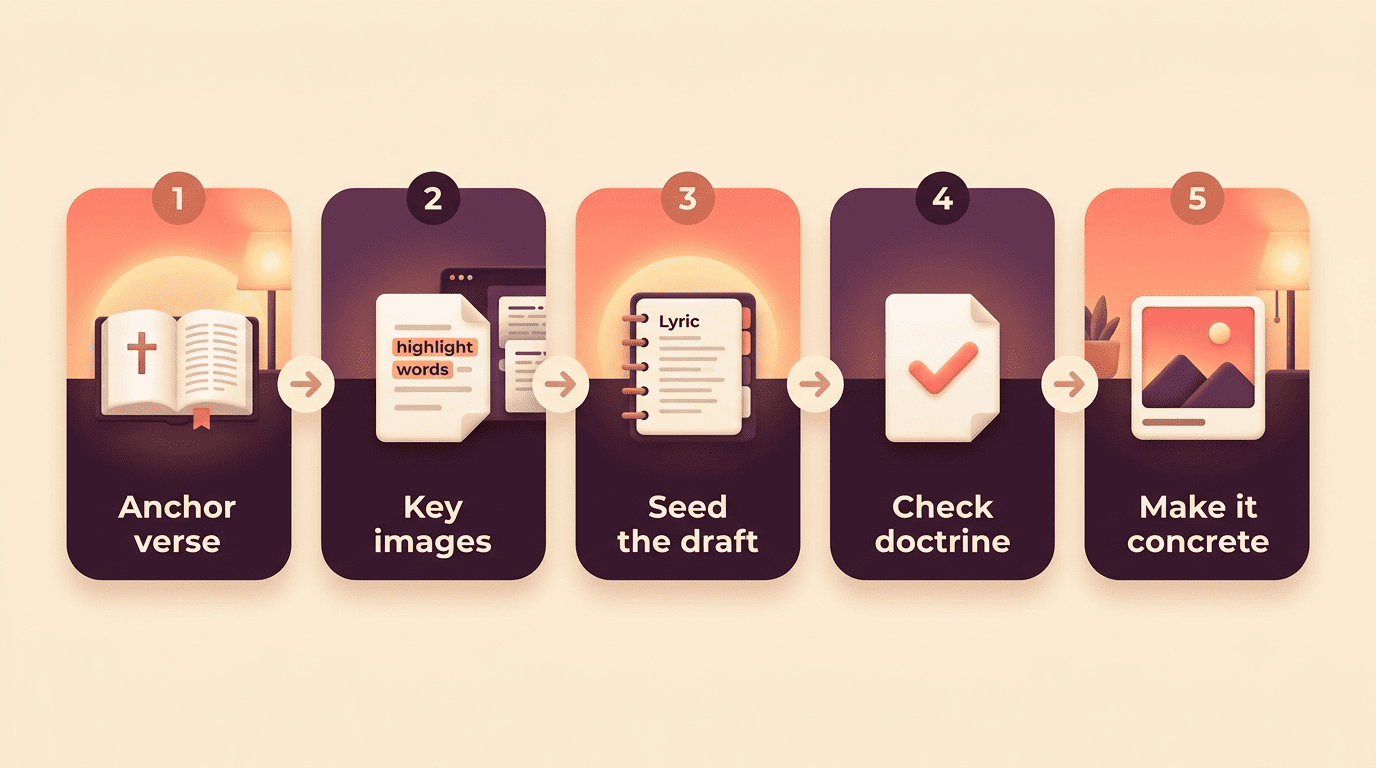
One caution matters more here than almost anywhere else in the writing process: AI can hallucinate a Scripture citation or misattribute a verse to the wrong book entirely. Every quoted or paraphrased reference needs to be checked against a reliable Bible text before it goes anywhere near a lyric sheet.
From verse to line: a grounding workflow
- Choose one anchor passage rather than a general theme
- Write out three to five key images or words directly from that passage
- Feed those images to the AI as a seed, along with an explicit theme and mood
- Check every doctrinal phrase in the draft against the source text
- Swap abstractions for concrete detail — turn a word like «freedom» into a specific, sensory image instead of leaving it as a label
Vertical vs. Horizontal Worship Lyrics
This distinction rarely gets explained clearly, but it’s one of the most useful tools for diagnosing why a worship lyric feels unfocused.
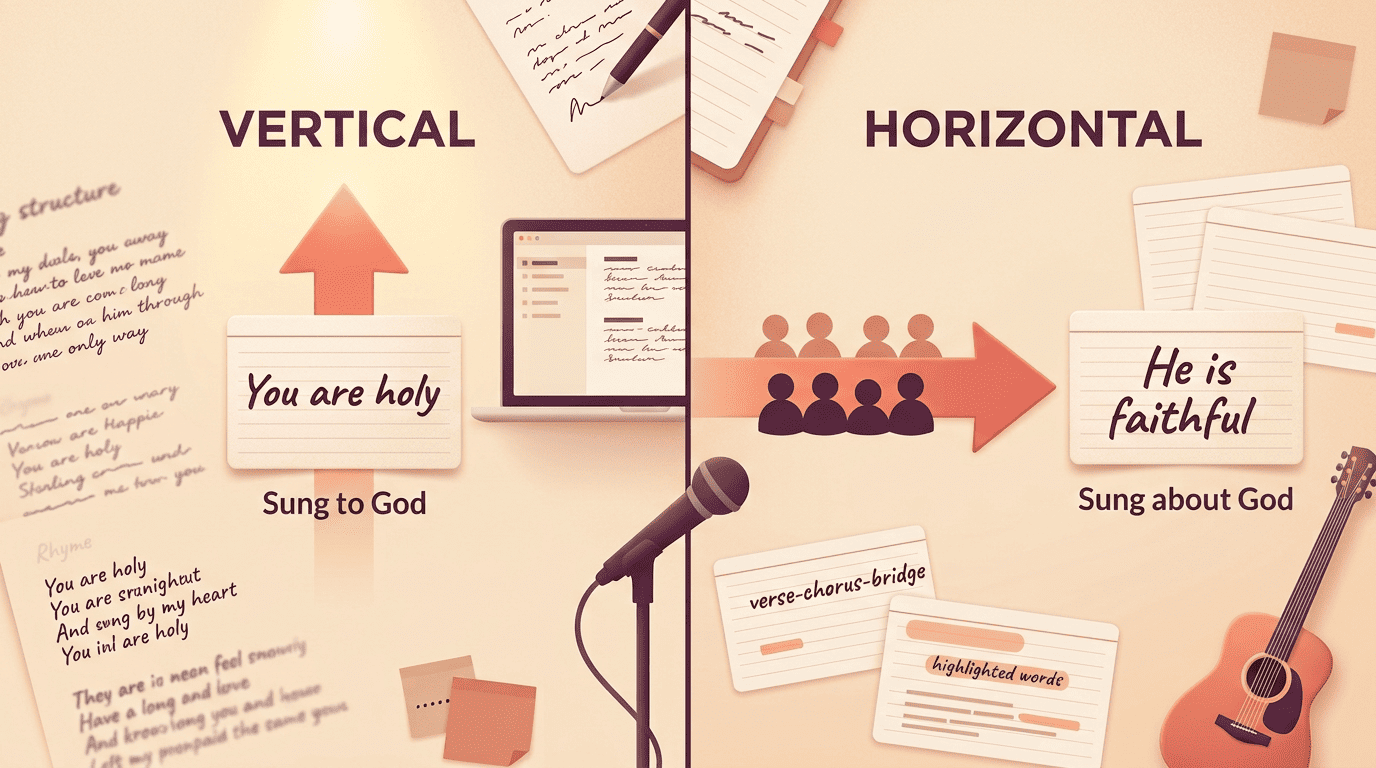
Vertical lyrics speak directly to God in second person — «You are holy,» «I surrender to You.» Horizontal lyrics speak about God or to the gathered church, often in third person or as a call to others — «He reigns,» «Come, let us worship.» Both are fully biblical; the Psalms do both constantly. The common mistake isn’t choosing one over the other, it’s mixing them without noticing, so a song drifts between addressing God and describing God without a clear throughline. Feeding a draft to an AI worship song generator with the instruction to label every line «V» or «H» is a fast way to spot where the focus wanders.
| Direction | Person / POV | Example line | When to use |
|---|---|---|---|
| Vertical | Second person, addressed to God | «I lift my hands to You» | Direct declarations of praise, surrender, prayer |
| Horizontal | Third person, about God or to the church | «He is faithful; come, let us sing» | Testimony, corporate calls to worship, teaching |
How to Structure a Worship Song
A typical worship song follows Verse 1, Chorus, Verse 2, Chorus, Bridge, Chorus — often closing on a final tag or refrain. Each section carries a distinct job. Verses build the story or the truth. They can move chronologically through a testimony or unpack one idea in layers, and they carry more information than any other section. The chorus is the central, singable declaration — the one line or two the whole room can say together without looking at a screen. The bridge is the emotional and theological peak, often the most vertical moment in the entire song, where the lyric shifts from describing to directly addressing God. An AI worship song generator handles this well when each section’s job is stated explicitly in the prompt, rather than asking for «a worship song» in one shot.
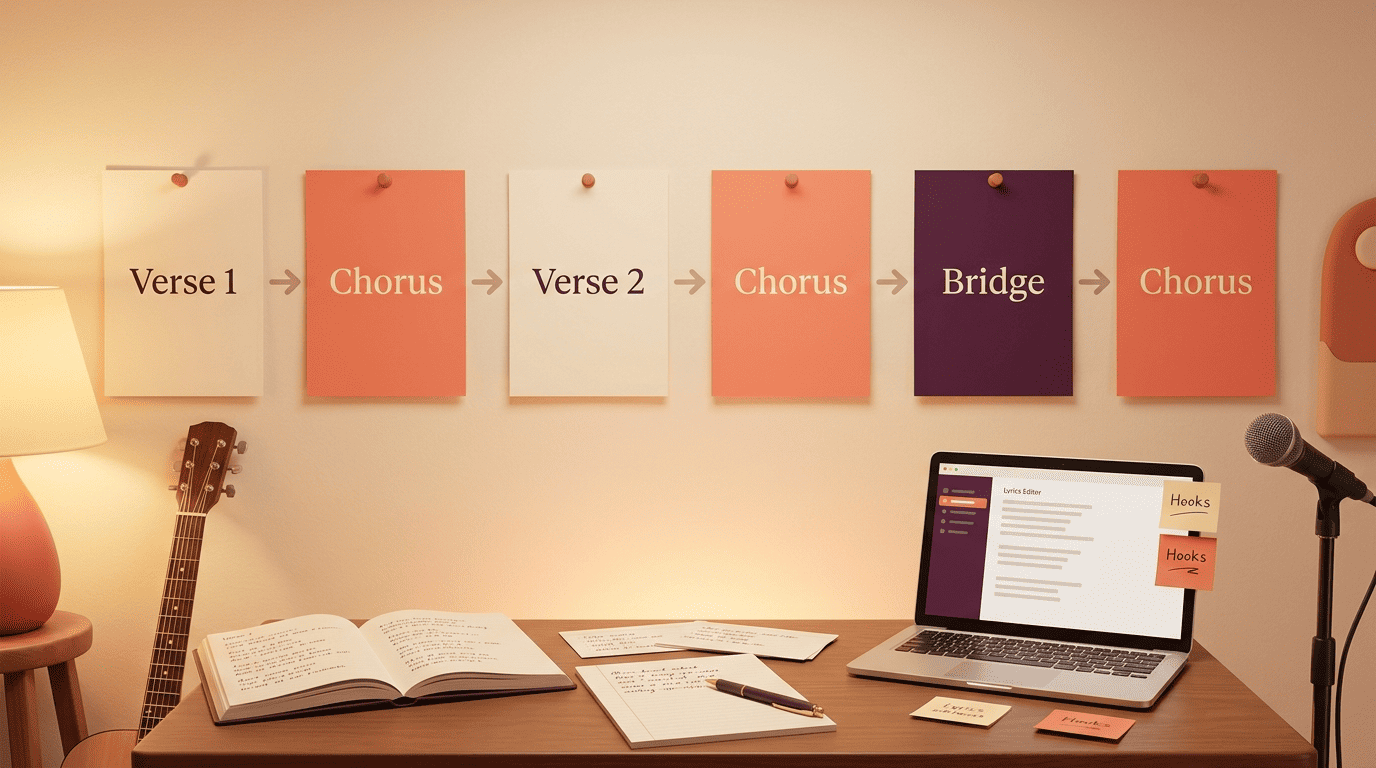
The chorus is the hook the church remembers
The chorus is what a congregation carries out of the building. Keep it short, repeatable, and built from plain language rather than clever wordplay. This isn’t a new problem: Charles Wesley, the eighteenth-century hymn writer credited with more than 6,500 hymns, built his most enduring choruses on dense, singable, doctrinally loaded lines — proof that «memorable» and «theologically serious» were never mutually exclusive. A strong chorus tends to share four traits:
- One clear idea, not three competing ones
- Singable vowels sitting on the longest, most sustained notes
- A repeated key phrase the congregation can lock onto by the second time through
- A narrow melodic range that doesn’t strand less confident singers
Writing for Congregational Singability
A song written for a congregation is not the same job as a song written for a solo vocalist.
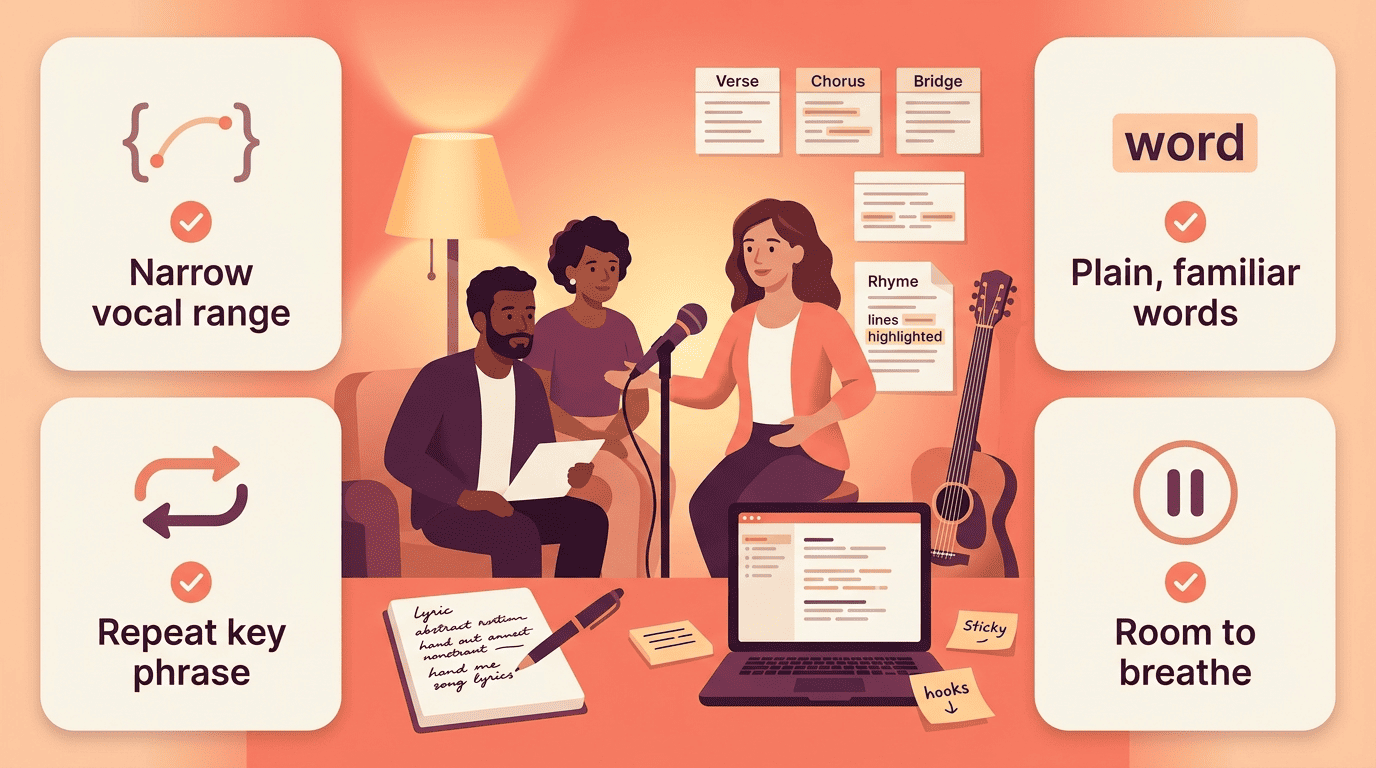
A few practical constraints keep a lyric singable by a room full of non-professional singers: keep the melodic range comfortable, roughly within an octave; avoid long multisyllabic words landing on fast notes; build in breathing pauses between phrases; and repeat key lines often enough that people can sing along without staring at a screen. An AI worship song generator can help by counting syllables against a target meter and flagging lines that stumble when sung out loud.
| Factor | Congregation-friendly | Avoid |
|---|---|---|
| Vocal range | About one octave, centered in a comfortable register | Wide leaps or extended high notes |
| Word choice | Short, plain, familiar words | Long or multisyllabic words on fast notes |
| Repetition | Key phrase repeated across chorus and tag | A new idea in every line |
| Phrasing | Clear breathing pauses between lines | Run-on lines with no natural breath point |
CCLI, Licensing, and Original Lyrics
CCLI — Christian Copyright Licensing International — issues the license that lets churches legally project, copy, and perform other songwriters’ copyrighted songs during a service. A song you wrote yourself, including one drafted with AI assistance, doesn’t need a CCLI license to be sung; that license exists for using someone else’s material, not your own.

Two things still deserve caution. A line that sits too close to an existing copyrighted song is a real risk, even if the resemblance wasn’t intentional — AI models can echo phrasing from their training data without flagging it as a quote. Adapting or quoting an existing hymn or copyrighted lyric changes the situation entirely, and that use case does call for permission or a license. None of this is legal advice; for a definitive answer on a specific song, CCLI or a qualified attorney is the right call, not a songwriting guide.
Keeping your worship lyrics original
A short checklist before a lyric leaves the draft stage:
- Run the finished text through a plagiarism or phrase-match check
- Rewrite any line that echoes a specific existing song too closely
- Keep drafts and revision history as a record of your own authorship
- Never publish an AI-suggested line without editing it in your own voice
- When in doubt, rewrite the line from scratch in your own words
The goal of an AI worship song generator is to help you finish your song, not to reassemble someone else’s.
A Simple Workflow: From Prayer to Finished Lyric
- Start with prayer and one anchor verse rather than a vague topic
- Give the AI a clear theme, mood, audience, and the chosen verse as a seed
- Generate two or three verse options and pick the strongest image, not just the smoothest line
- Lay out the structure — Verse, Chorus, Verse, Chorus, Bridge, Chorus — and mark each line vertical or horizontal
- Tighten the chorus for singability: check range, repetition, and syllable count
- Check every doctrinal line against Scripture and confirm the lyric is original
- Hand the draft to a live team, or an audio engine if you need a track, and revise based on how it actually sings in the room