
AI Song Lyrics Generator: How to Write Song Lyrics You’ll Be Proud Of
An ai song writer built for lyrics is really just a tool that turns a spark — a theme, a mood, a single line you can’t stop humming — into full verses, choruses and hooks in seconds. It doesn’t replace your voice as a songwriter; it clears the blank page so you actually have something to react to, edit, and make your own. That distinction matters, because lyrics themselves are simply the words set to a song, and the craft behind them goes back centuries, as Wikipedia’s overview of lyrics lays out.
Most people don’t open one of these tools looking for a finished masterpiece. They open it stuck — staring at an empty page at 11pm, humming a melody with no words to match. An AI song lyrics generator meets you there, not at the finish line.
What Is an AI Song Lyrics Generator?
At its core, an AI lyrics generator is a text tool: you give it a prompt — a theme, a mood, a genre, maybe a couple of keywords — and it writes a draft song text back. That draft usually includes verses, a chorus, and sometimes a bridge or hook, already shaped like a song rather than a paragraph of prose. Think of it less as a vending machine and more as a songwriting partner who never runs out of ideas at 2am.
Not every AI lyric generator works the same way under the hood. Some are built on general-purpose large language models — the same family of AI that powers chatbots and writing assistants — repurposed for song lyrics. Others are purpose-built songwriting models trained specifically on lyrical patterns, rhyme, and song form, which tends to make their output feel more naturally «song-shaped» from the first draft. Either way, the input side looks similar: you’re usually choosing a theme, an emotional tone, and a genre before you hit generate.
How it actually works (under the hood, lightly)
- You give the tool a prompt — a theme, a mood, a genre, or a line you already love.
- The underlying model predicts word and line sequences that fit your theme, a rhyme pattern, and a rough meter.
- It returns a structured draft, typically organized into verse, chorus, and sometimes bridge sections.
- You read it, keep what resonates, and rewrite the rest in your own voice.
What you can ask it for
An AI lyrics maker is more flexible than a single «write me a song» button. Once you’re inside one, you can typically ask for:
- A full set of verses on a given theme
- A catchy chorus or hook built around one repeatable line
- A bridge that shifts the emotional angle of the song
- Rhyme options for a specific word you’re stuck on
- A title that captures the song’s core idea
- A mood rewrite — same lyrics, sadder or more hopeful
- A genre switch, turning a folk lyric into a pop or R&B one
From Blank Page to First Verse: Using an AI Lyrics Generator Step by Step
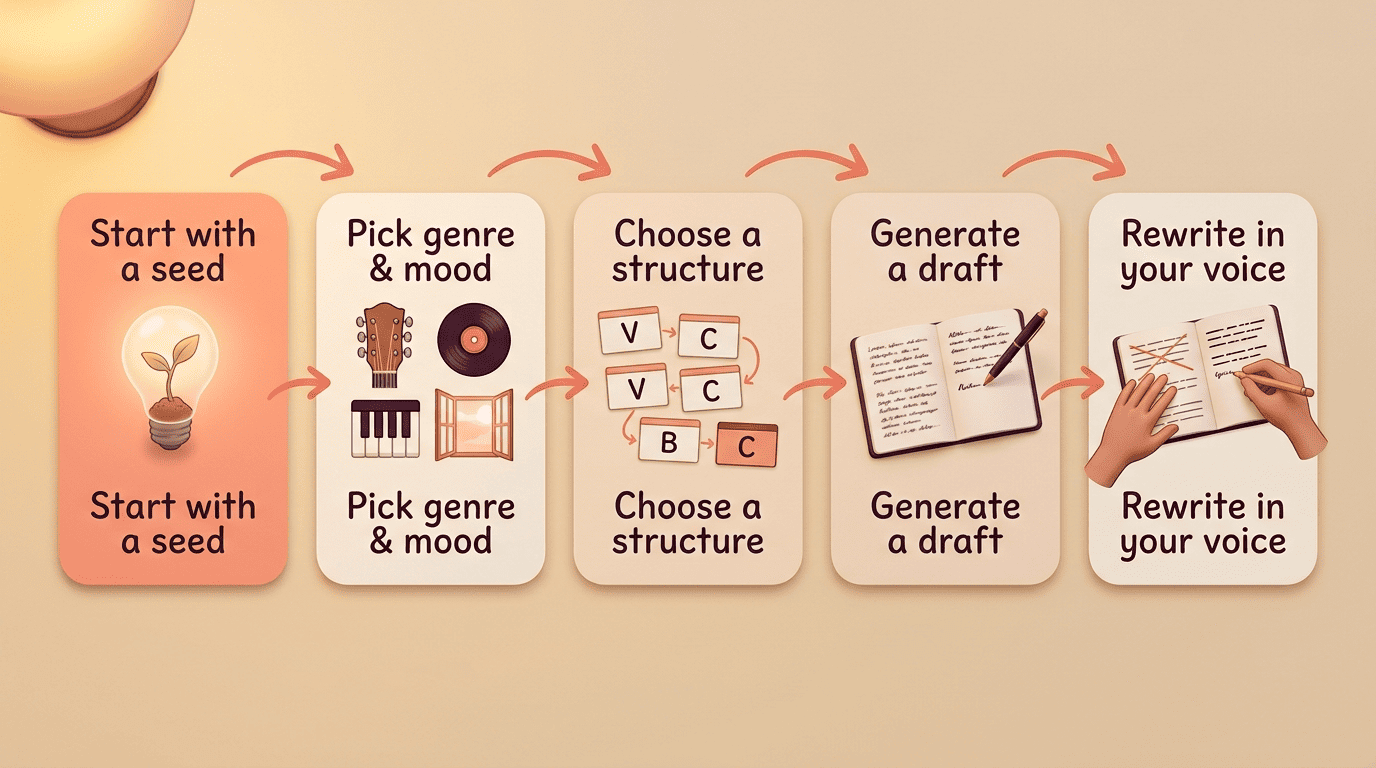
Using an ai songwriting tool doesn’t require any music theory or production skill — just a starting idea and a few minutes. Most tools follow a simple three-step flow: you enter an idea, the AI generates a draft, and then you edit and use it. Some let you go deeper with specific parameters like genre, emotion, duration, language, and structure, so the first draft already leans closer to what you hear in your head.
The nice part is that none of this is precious. A weak first draft is not a failed one — it’s raw material. You’re not trying to get it perfect on the first generate; you’re trying to get something on the page you can push against.
Step-by-step
- Start with a seed — a theme, a feeling, or a line you already love.
- Pick a genre and a mood that match the song you’re imagining.
- Choose a structure, like verse-chorus-verse-chorus-bridge-chorus.
- Generate a first draft and read it all the way through once, without editing.
- Rewrite lines in your own voice, swapping generic phrasing for your specific details.
- Read it out loud — or better, sing it — to hear where it stumbles.
Writing a prompt that gets great lyrics
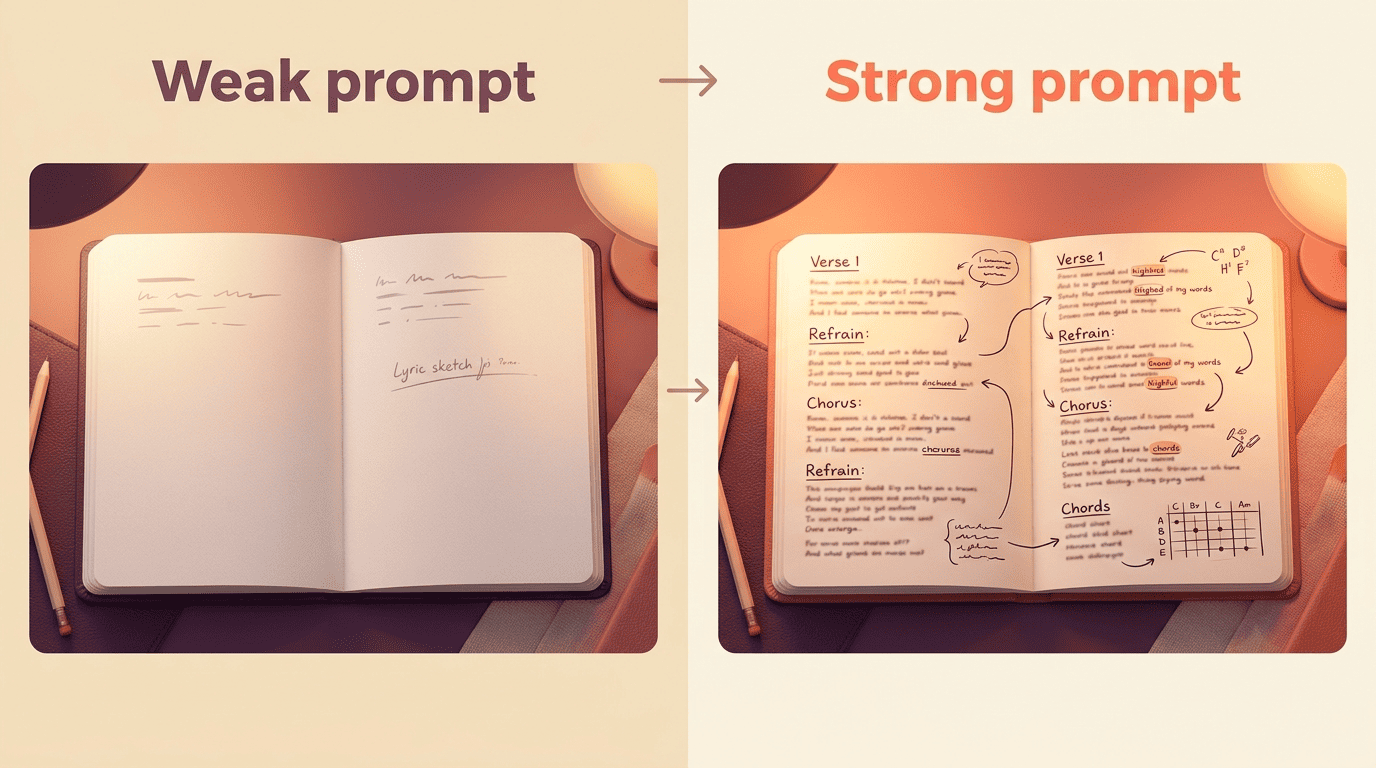
The difference between a flat draft and a genuinely usable one is almost always the prompt. Vague prompts get vague lyrics; specific, sensory prompts get lyrics with texture.
| Weak prompt | Stronger prompt | Why it works |
|---|---|---|
| «Write a love song» | «Write an upbeat indie-pop chorus about a long-distance couple reuniting at an airport, hopeful, present tense» | Gives genre, scene, tense, and emotional target |
| «Write about heartbreak» | «Write a slow country verse about packing up a shared apartment alone, focused on one specific object left behind» | Adds a concrete image instead of an abstract feeling |
| «Make a rap song» | «Write a confident hip-hop verse about starting over in a new city, using internal rhyme and short punchy lines» | Names the sub-genre, rhyme style, and line length |
| «Write something sad» | «Write a bridge that shifts from anger to acceptance about losing a friendship, using second person (‘you’)» | Specifies structure, emotional arc, and point of view |
Song Structure: Verse, Pre-Chorus, Chorus, Bridge, Hook
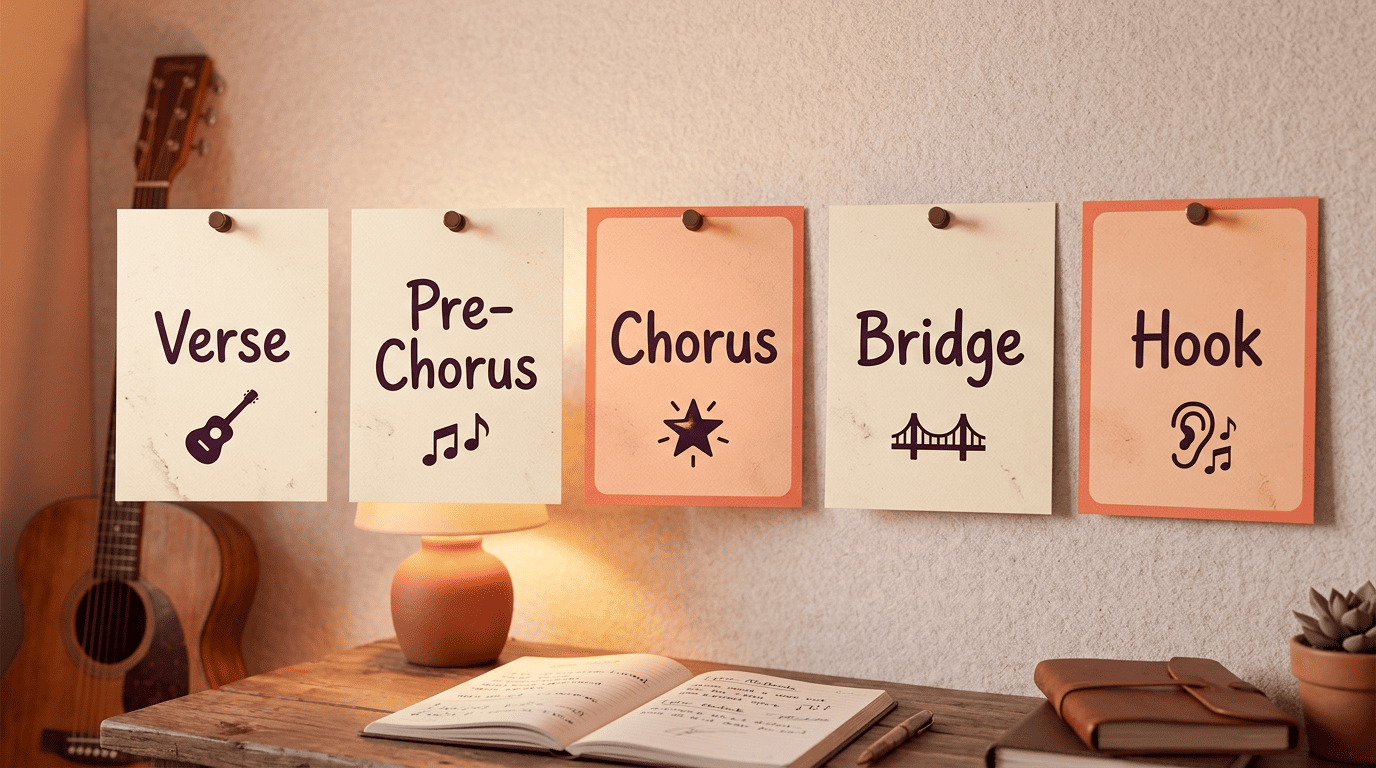
Song structure is the skeleton that holds a set of lyrics together, and most AI-generated drafts default to a familiar shape: two verses, a chorus, and a bridge. Understanding what each section is for — not just what it’s called — helps you edit an AI draft into something that actually builds and releases tension the way a good song should. For a deeper technical breakdown, Wikipedia’s entry on song structure is a solid reference.
The parts of a song, in plain English
| Section | What it does | Songwriter tip |
|---|---|---|
| Verse | Tells the story, sets the scene, moves the narrative forward | Keep verses concrete — specific images beat vague statements |
| Pre-Chorus | Builds tension and momentum right before the chorus lands | Shorten your lines here to speed up the pacing |
| Chorus | Delivers the song’s main idea, repeated and easy to remember | The first and last line should be nearly identical for repeatability |
| Bridge | Shifts perspective or emotion before the final chorus | Use it to say the one thing you haven’t said yet |
| Hook | The single most memorable phrase or melody-and-lyric moment | Make it short enough to shout back after one listen |
Genres and Moods: Making the Lyrics Sound Like You
Pop. Pop lyrics thrive on a hook-first mindset — write the chorus before the verses, keep the vocabulary simple, and repeat the emotional core line more than once.
Rap and hip-hop. These genres lean on internal rhyme and flow, so it helps to read every line out loud and count syllables against the beat in your head as you write.
Country. Country lyrics are built on story and concrete detail — a specific truck, a specific road, a specific year — rather than general feelings.
R&B. R&B rewards feel and space, meaning fewer words per line and more room for the melody to breathe between phrases.
Indie. Indie lyrics tend to favor imagery over direct statement — let a metaphor do the emotional work instead of naming the feeling outright.
Most generators support well over a dozen genres and dozens of mood or emotion tags, so it’s worth trying the same theme through two or three genre settings before you settle — the underlying idea often survives, but the phrasing changes completely.
Rhyme, Rhythm and Prosody: Small Details That Make Lyrics Sing
Rhyme is one of the first things people notice about lyrics, but it’s the relationship between rhyme, rhythm, and melody — what musicians call prosody — that makes a line actually singable. A perfect rhyme matches sounds exactly, while a slant or near rhyme matches only part of the sound, giving you more flexibility without breaking the pattern entirely. Common rhyme schemes like AABB or ABAB give a lyric its shape, and matching your stressed syllables to the strong beats of your melody is what keeps a line from feeling clunky when sung. You can read more about the mechanics in Wikipedia’s rhyme scheme entry. Most AI lyric generators will actively suggest rhymes for a specific word if you get stuck, which is often the fastest way to break through a stalled verse.
Quick rhyme cheat-sheet
- Perfect rhyme — identical vowel and ending sounds, like «night» and «light»
- Slant/near rhyme — similar but not identical sounds, like «heart» and «hurt»
- Internal rhyme — a rhyme that lands inside a single line, not just at the end
- Multisyllabic rhyme — matching two or more syllables in a row, common in rap
Choosing an AI Lyrics Generator: What to Look For
Not every AI song lyrics generator solves the same problem. Some are built as one feature inside a bigger design or music suite, others are purpose-built for songwriting from the ground up. General-purpose tools tend to be flexible and fast to try, purpose-built songwriting tools tend to understand structure and rhyme more naturally, and suite tools are convenient if you’re already inside that ecosystem for other reasons — but each comes with its own trade-offs worth checking before you commit.
Before settling on one, run through this checklist:
- Can you actually edit the output line by line, or only regenerate the whole thing?
- Does it let you control structure (verse count, bridge, hook) or just spit out one block?
- Does it offer rhyme suggestions when you’re stuck on a specific word?
- How many genres and moods does it actually cover well?
- Does it clearly state that you keep the rights to what you write with it?
- Is there a usable free tier, or is everything gated behind a paywall?
Are AI-Generated Lyrics Original? A Friendly Note on Copyright
Here’s the honest, non-scary version: use an ai lyrics writer as your starting point, then make the lyrics genuinely yours by rewriting lines in your own voice, adding your own specific details, and shaping the structure around your story. What you should never do is lift lines directly from someone else’s copyrighted song — that’s true whether you found the line in an AI draft or anywhere else.
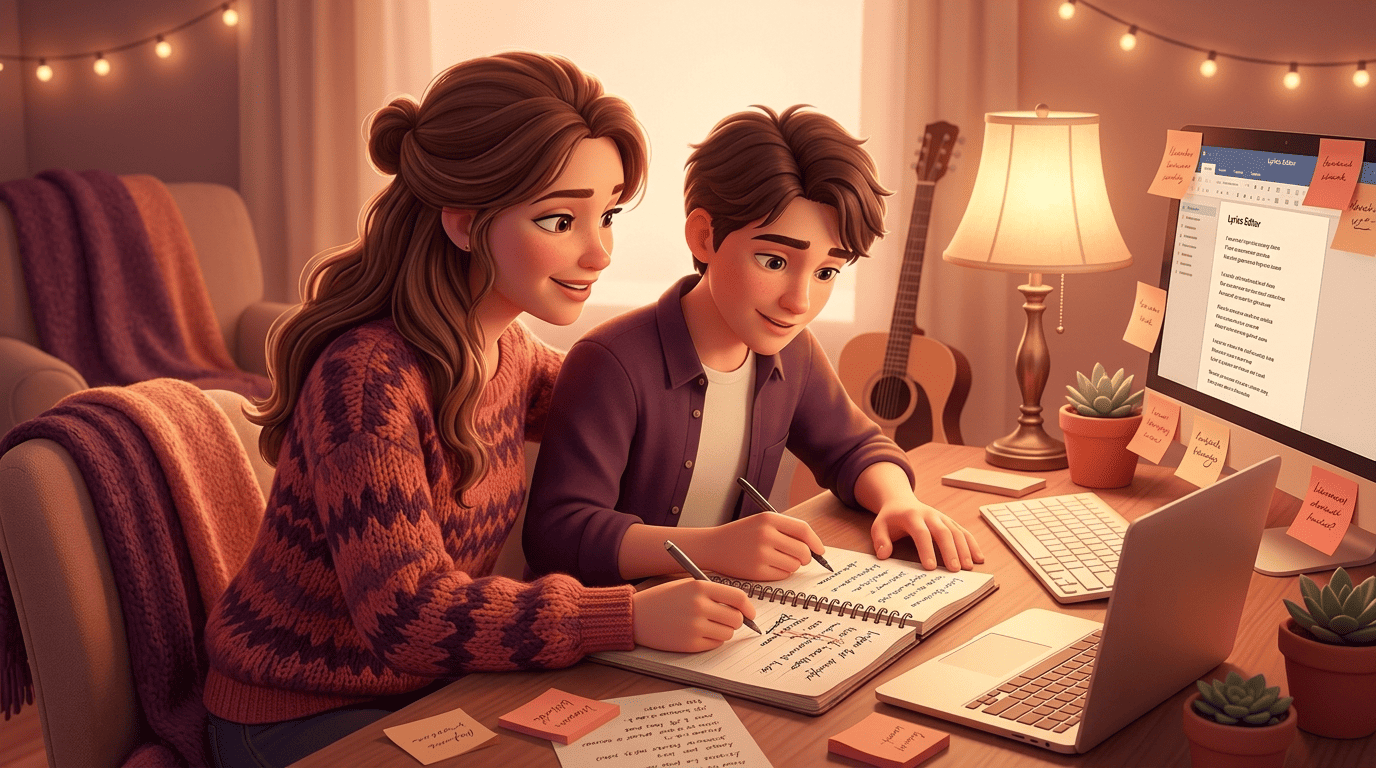
Policies vary by tool — some grant you ownership of the generated output outright, while others don’t guarantee exclusivity, so it’s worth reading the terms of whichever tool you use. On the legal side, the U.S. Copyright Office has stated that purely AI-generated material, without meaningful human authorship, isn’t eligible for copyright protection on its own — it’s the human edits, arrangement, and creative choices you add on top that become protectable. You can read the official Copyright Registration Guidance on AI-generated material directly. Organizations like ASCAP exist specifically to help songwriters understand and collect on their rights once a song is finished and performed.
The Office will not register works produced by a machine or mere mechanical process that operates randomly or automatically without any creative input or intervention from a human author.U.S. Copyright Office, Copyright Registration Guidance
The friendliest way to think about it: AI gives you a first draft to argue with, not a finished, ownable song. Your rewrite is what makes it truly yours.
Tips to Turn a Good Draft Into a Song You Love
- Read the whole draft aloud before you change a single word
- Cut filler words and phrases that don’t earn their place
- Keep one strong image per section instead of five weak ones
- Make the hook short and repeatable enough to shout back after one listen
- Sing the melody over the lyrics, not just read them silently
- Edit until the story matches something true about your own life