
AI Song Writer: Your Warm, Creative Partner for Writing Song Lyrics
An AI song writer is a creative co-writer that turns a spark — a mood, a memory, a single line — into full song lyrics: verses, a chorus, a bridge. Under the hood sits a large language model, trained on the language and structure of songs, so it can shape a raw idea into something that actually scans and rhymes.
It’s here to help you beat the blank page, not replace your voice. You stay in the driver’s seat — picking the theme, the feeling, the line that has to stay — while the AI handles the heavy lifting of drafting, rhyming and structuring. And to be clear from the start: this is about lyrics, the words of a song, not about generating audio, vocals or a finished track.
What Is an AI Song Writer?
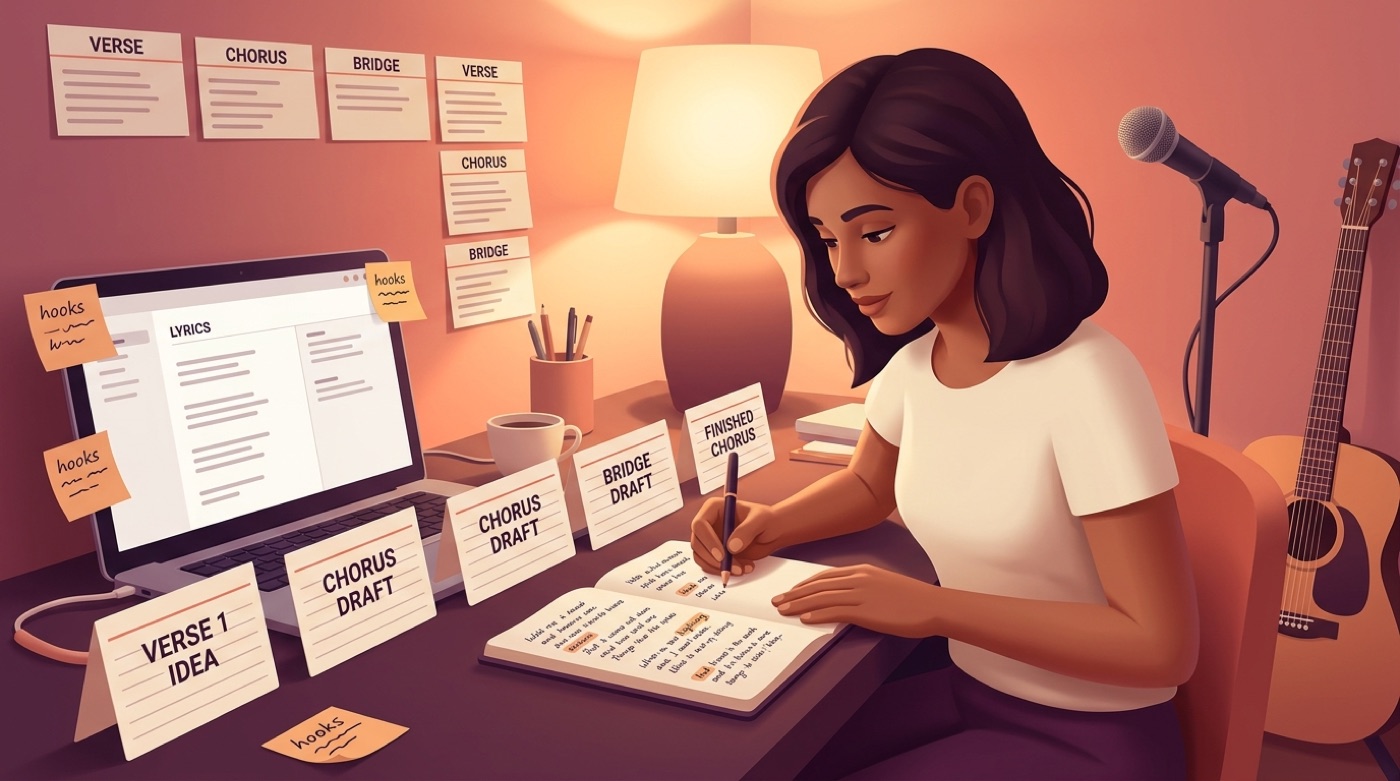
An AI song writer is a digital co-writer built to understand themes, emotions and song structure the way a human lyricist does. You give it a prompt — a mood, a topic, a genre — and it hands back verses, choruses and bridges shaped around that idea. It isn’t a jukebox spitting out random words; it’s a system fine-tuned on songwriting patterns, rhyme schemes and genre conventions, so the lines it produces already sound like they belong in a song rather than a paragraph of prose.
A songwriting partner, not a jukebox
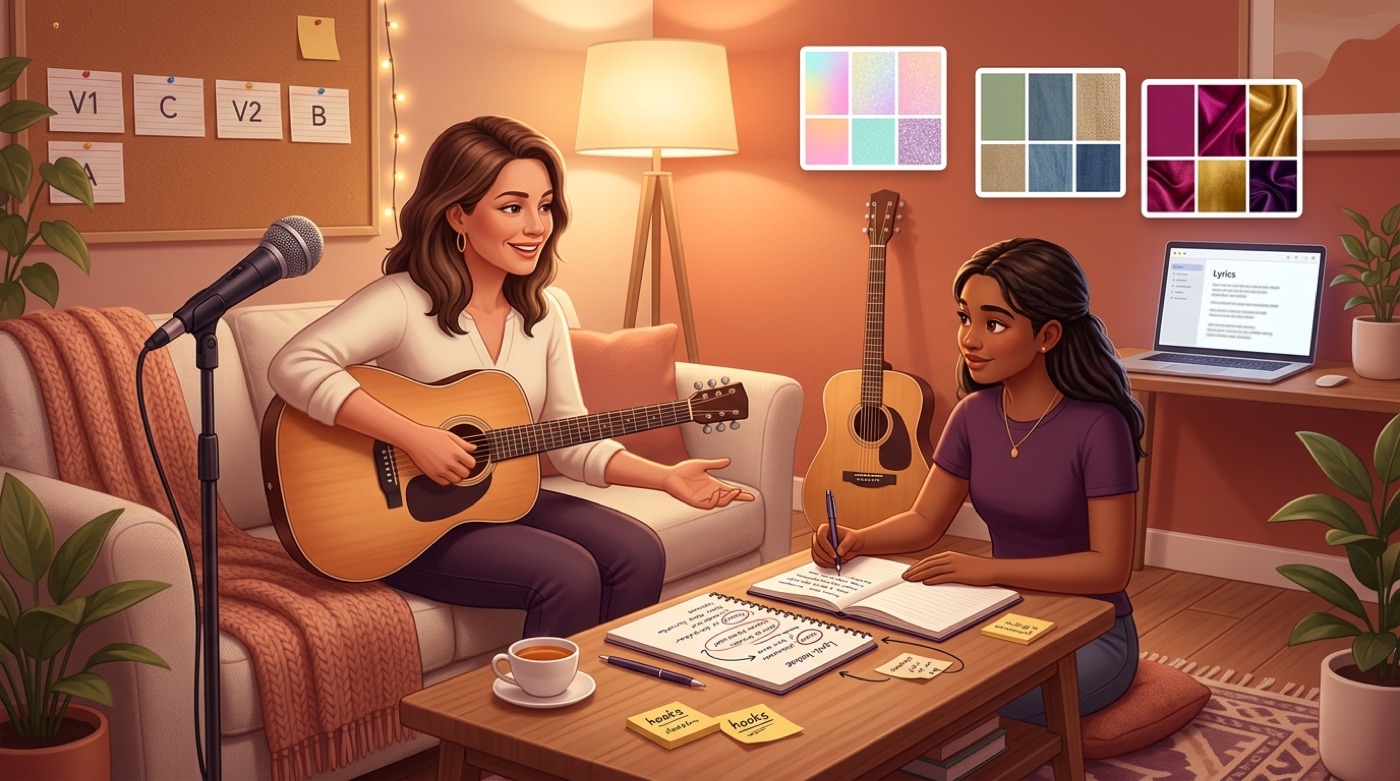
Think of it less as a vending machine and more as a collaborator who never runs out of ideas at 2am. You describe what you’re going for — a theme, an emotion, a genre — and the AI lyric writer proposes a structure and fills it in. The output is a starting point, not a finished, untouchable product: your job is still to shape it into something that sounds like you. Songwriting has always been about craft as much as inspiration, and an AI songwriting assistant is built to support that craft, not stand in for it.
Lyrics writer vs. music generator — know the difference
It’s worth being precise here, because the two get lumped together constantly. An AI music or audio generator produces sound — a vocal performance, an instrumental track, a finished mix. An AI song writer / lyric writer works exclusively with words: lyrics, rhyme schemes, verse-chorus-bridge structure. Lyrivo sits firmly in the second camp — it’s about the text of your song, the part you can read, edit, and make your own before anyone ever touches a beat.
| AI Lyric Writer | AI Music Generator | |
|---|---|---|
| What it produces | Written song lyrics (verse, chorus, bridge) | Audio: vocals, instrumentals, a mixed track |
| Input | Theme, mood, genre, keywords | Genre, style prompt, sometimes lyrics |
| Output format | Editable text | Audio file (MP3/WAV) |
| Best for | Songwriters, lyricists, poets shaping words | Producers who want a finished sound without writing music |
| Your role | Editor and author of the words | Curator of a generated sound |
How Does an AI Song Writer Work?
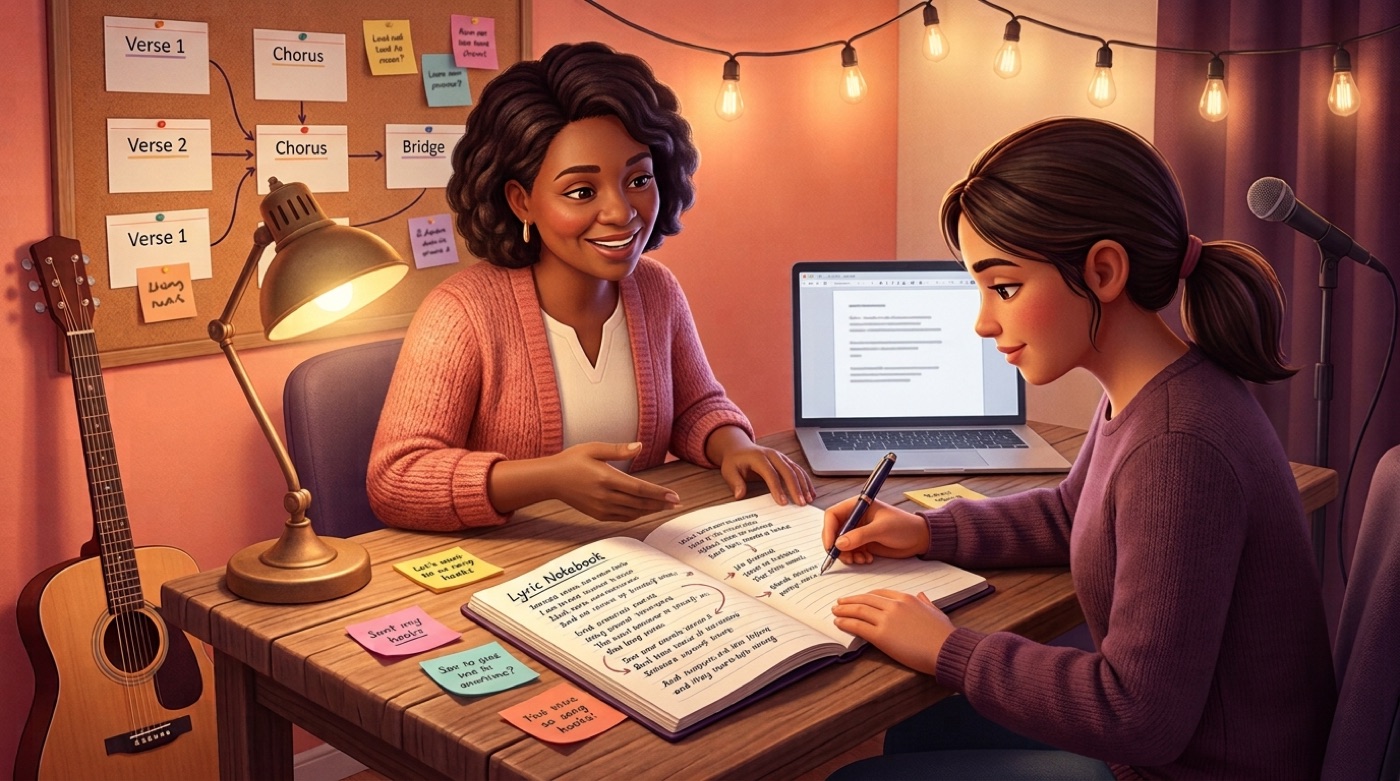
At its core, an AI song writer runs on a large language model trained on enormous amounts of text, including song lyrics across genres, rhyme patterns, and structural conventions. When you type a prompt, the model isn’t retrieving a pre-written song — it’s predicting the most fitting next words, line by line, based on patterns it learned from millions of examples. The result is a fresh set of lyrics shaped around your specific input.
From prompt to verses in seconds
- You enter a theme, mood, genre and a few keywords — the more specific, the better.
- The model draws on patterns from song lyrics and genre conventions it has learned, predicting word by word, line by line, what fits the request.
- It applies rhyme and structural rules, aiming for a working rhyme scheme and a recognizable form.
- It assembles the output into a structured set of lyrics — typically two verses, a chorus, and a bridge.
- You read it, keep what works, and ask for another pass on the parts that don’t.
The whole cycle from prompt to a full draft usually takes seconds, which is exactly what makes it useful for breaking through writer’s block rather than staring at an empty page.
Why a songwriting-tuned model beats a generic chatbot
A generic chatbot can write lyrics too, but it tends to lean on the same handful of predictable images — neon lights, whispers, kaleidoscopes — and often settles into one rhyme scheme for the entire song, whether or not it fits the genre. It also tends to interpret prompts literally rather than emotionally. A model tuned specifically on songwriting has absorbed genre conventions, varied rhyme schemes, and song form (verse-chorus-bridge, AABA, call-and-response) in a way a general-purpose assistant hasn’t, so the lyrics it returns are more likely to sound like an actual song rather than a poem split into stanzas.
What Can an AI Song Writer Do?
An AI lyrics generator covers most of what a human co-writer would help with on the page: drafting full lyrics, matching rhymes, building hooks, shaping structure, adapting to a genre or mood, and revising what doesn’t land. Here’s the range in practice.
- Write full lyrics from a single prompt — theme, mood and genre in, a structured song out.
- Match rhymes and rhythm so lines land on the beat instead of just sharing a vowel sound.
- Build a memorable hook for the chorus, the part meant to stick in someone’s head.
- Structure the whole song — verse, chorus, bridge, and optional pre-chorus or intro/outro.
- Adapt to genre and mood, from a stripped-down folk ballad to a hard-hitting rap verse.
- Edit and regenerate any section without starting the whole song over.
Write and finish lyrics
Give it a theme and genre, and an AI song writer can produce complete lyrics — typically two verses, a chorus and a bridge — in one pass. You can also ask for a single section on its own: just a chorus, just a second verse, just a bridge that shifts the emotional tone. That flexibility matters when you already have half a song and only need the AI to fill a gap.
Nail rhymes, hooks and flow
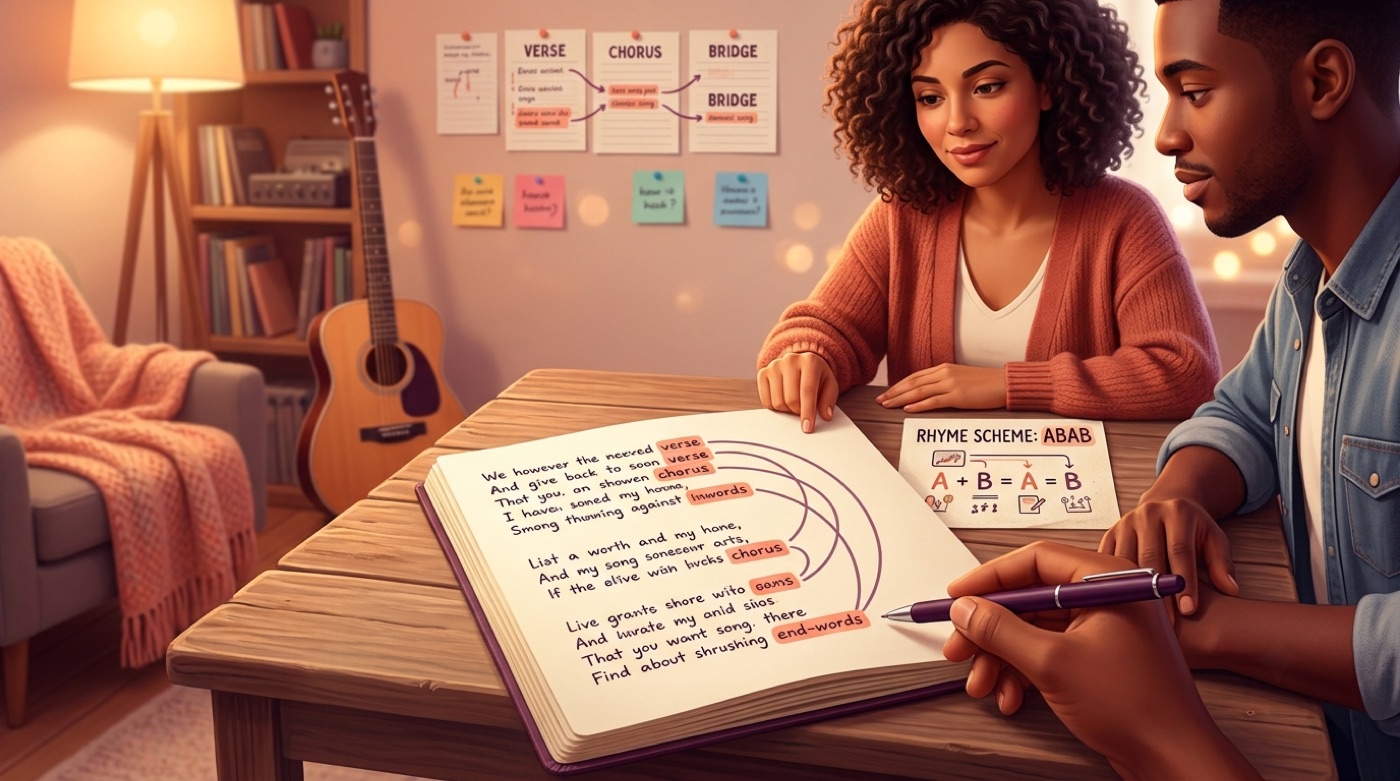
Rhyme is where a lot of amateur lyric-writing falls apart, and it’s exactly where an AI song writer earns its keep. It can match rhyme schemes — AABB, ABAB, internal rhyme — and vary them across sections instead of repeating the same pattern for four minutes straight. It can also propose a hook built to be repeated and remembered, and keep the flow and rhythm of a line tight enough to sit naturally over a beat.
Build song structure
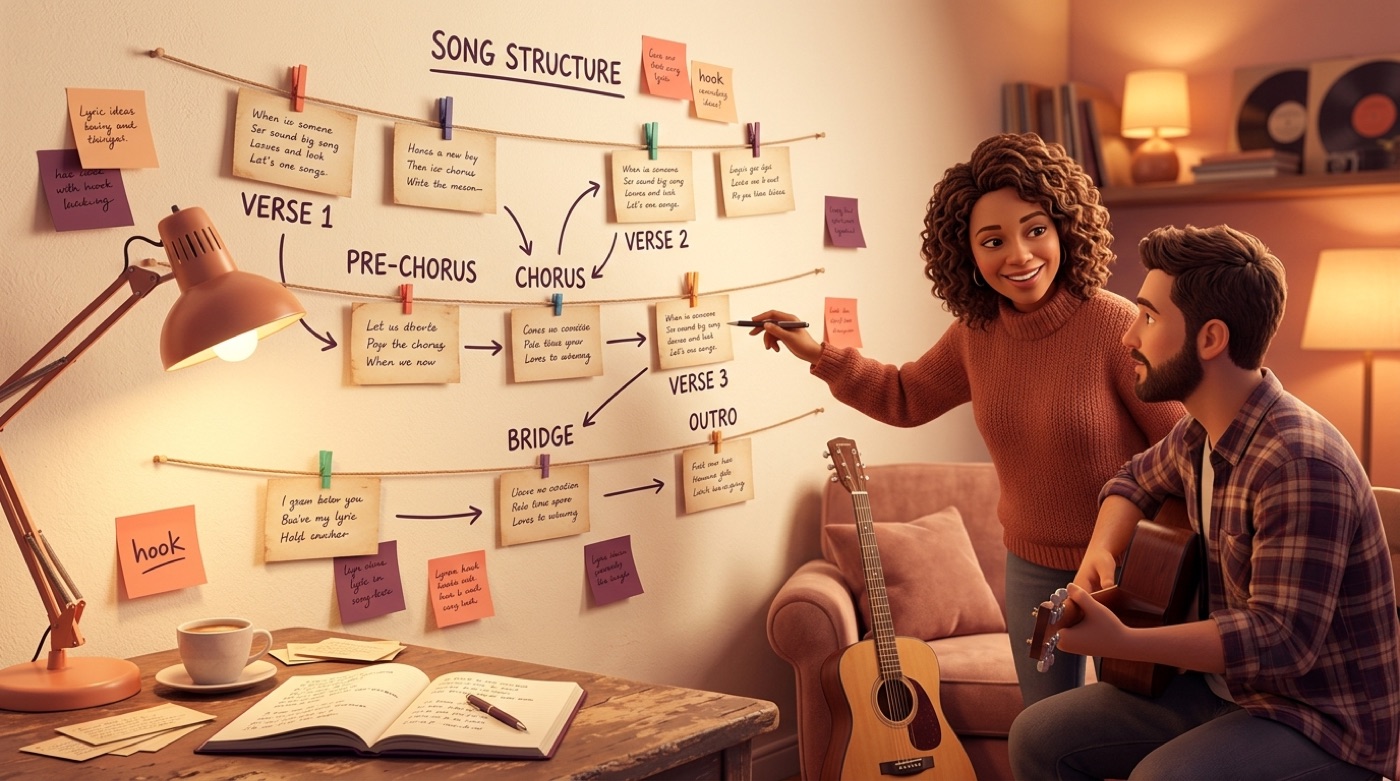
Every song leans on some version of the same architecture. A verse-chorus-bridge structure is the most common modern form, but plenty of songs use a pre-chorus, an intro and outro, or the older AABA pattern. Here’s what each piece typically does:
- Verse — moves the story forward, gives specific details and changes with each repetition.
- Pre-chorus — builds tension and leads the ear toward the chorus.
- Chorus — carries the main hook and emotional payoff, usually repeated with little change.
- Bridge — offers a tonal or perspective shift, a break from the pattern before the final chorus.
- Intro / outro — frame the song, setting or closing the mood.
Adapt to any genre and mood
An AI song writer can flex across pop, rap and hip-hop, country, rock, R&B and soul, indie, folk, gospel and worship, musical theatre, EDM, and more — each with its own vocabulary, imagery and rhythmic feel. Mood matters just as much as genre: you can steer the emotional arc of a song, sometimes blending two or three emotions, so a track can open in doubt and close in resolve rather than sitting flat on one note the whole way through.
| Genre | Typical vibe | Lyric hallmark |
|---|---|---|
| Pop | Upbeat, hooky, broadly relatable | Short lines, strong repeated chorus hook |
| Rap / hip-hop | Rhythmic, direct, narrative-driven | Dense internal rhyme, wordplay, flow tied to the beat |
| Country | Storytelling, grounded, sincere | Concrete imagery, narrative verses, plainspoken chorus |
| Rock | Energetic, raw, anthemic | Punchy short phrases, big singable chorus |
| R&B / soul | Emotional, smooth, intimate | Flowing melodic lines, repetition for emphasis |
| Gospel / worship | Uplifting, communal, reverent | Call-and-response, declarative praise language |
Edit, refine and regenerate
The first draft is rarely the final one, and that’s fine — it’s meant to be a starting point. You can regenerate a single section that isn’t working, swap out a weak line without touching the rest of the song, or ask for a different tone on the same theme. Treat the AI’s output the way you’d treat a rough demo: keep the parts that hit, rewrite the parts that don’t, and let the tool do another pass whenever you need one.
How to Use an AI Song Writer Well (Prompting)
The quality of what you get back depends heavily on what you put in. A vague prompt gets a generic song; a specific one gets something that actually sounds like it came from your life.
Give it something real to work with
“Heartbreak” is a category. “Regretting a text I sent at 2am” is a song. The more concrete and personal the detail, the less generic the output. Before you prompt, jot down:
- The core theme or story you want the song to tell.
- A specific real-life moment or image tied to that theme.
- An idea for the hook — the line you want people to remember.
- Any imagery or metaphor you already like.
- Point of view — first person, second person, storyteller.
Steer style, structure and rhyme
Beyond the theme, tell the AI song writer exactly how you want it built. Custom instructions do a lot of work here — things like “write in AABA with a strong chorus hook,” “keep it first-person and conversational,” “add a bridge with a tonal shift,” or “keep the lines short so it sits well over a fast beat.” A quick prompt checklist before you generate:
- Theme and up to two or three emotions you want in the arc.
- Genre and general mood.
- Preferred rhyme scheme, if you have one.
- Point of view and any specific keywords or imagery to include.
- Structural notes — pre-chorus, bridge tone, line length.
Iterate like a songwriter
Generate more than one version. Save the individual lines that actually land, even from a version you otherwise discard, and combine the strongest pieces into a single draft. This is the same process professional songwriters use with a co-writer — nobody nails the whole song on the first pass. Your creative direction, the choices you make about what to keep, is what ultimately makes the song stand out.
Limitations: Where You Still Lead
An AI song writer is fast and useful, but it isn’t a substitute for your ear or your story. It can lean on familiar, generic imagery when a prompt is vague, and it can settle into a single rhyme scheme for an entire song if you don’t push back. It also doesn’t feel your specific memory the way you do — it’s working from patterns, not lived experience — so it can occasionally misjudge the stress or syllable count of a line (its prosody) in a way that reads fine but doesn’t quite sing right. And it doesn’t know your voice: the particular phrasing, references and tone that make a song sound like it came from you.
Fast first drafts and structural scaffolding. An AI song writer is at its best when you need something on the page quickly — a full structure to react to, rhyme suggestions to build on, a way through writer’s block, or an excuse to try a genre you don’t normally write in. That’s where it saves the most time.
Grounding the song in something real. Generic prompts get generic output, so it’s on you to bring the specific memory, the exact phrase, the detail nobody else would think to include. The AI can dress that detail in a structure and a rhyme, but it can’t invent the memory itself.
Catching what doesn’t quite sing. Forced rhymes and awkward stress patterns can slip through — a line that scans fine on paper but trips when you actually try to sing it. Reading each draft out loud, or singing it against a rough melody, is still the fastest way to catch what the model missed.
Giving the song its final emotional truth. The last pass — deciding which lines truly sound like you, cutting what feels borrowed, keeping the one image that makes the song personal — is still entirely yours. The AI can hand you ninety percent of a draft; the last ten percent is where the song becomes real.
Use it as a drafting accelerator. The final soul of the song — the part that makes a listener stop scrolling — is still yours to bring.
Originality and Copyright: Write Songs That Are Truly Yours
Human authorship is a prerequisite for copyright protection… the Office will not register works produced by a machine or mere mechanical process that operates randomly or automatically without any creative input or intervention from a human author.
U.S. Copyright Office
Write original lyrics. Use the AI as a springboard for your own idea, not as a way to reproduce an existing song or someone else’s specific lines — that’s the difference between drafting with a tool and copying someone’s work. Before you release anything, it’s worth running a plagiarism check to catch accidental overlaps with existing songs; most lyric-writing tools that promise “royalty-free” or “original” output still recommend this step, and it’s a good habit regardless of which tool you use.
On the legal side, it’s worth understanding the nuance without treating it as a scare story. The U.S. Copyright Office has clarified that purely machine-generated material, produced without meaningful human creative input, generally isn’t eligible for copyright registration. But a human’s creative contribution — the editing, the selection of which lines stay, the structural decisions, the personal detail you added — can be protected. In practice, that means the more of yourself you put into shaping the final lyrics, the more clearly the song is yours, legally and creatively.
Frequently Asked Questions
- What is an AI song writer?
An AI song writer is a digital co-writer that turns a prompt — a theme, mood or genre — into structured song lyrics: verses, a chorus, a bridge. It works with words, not audio.
- How does an AI song writer work?
It runs on a large language model trained on song lyrics and structure. You give it a theme, genre and mood, and it predicts fitting lines based on learned patterns, returning structured lyrics in seconds.
- Can I use AI-generated song lyrics commercially?
Many tools offer royalty-free output, but run a plagiarism check before release and add your own creative edits. The U.S. Copyright Office notes that purely machine-generated text may not be eligible for registration, while meaningful human contribution can be.
- Is an AI song writer better than ChatGPT for lyrics?
A songwriting-tuned model understands genre conventions, varied rhyme schemes and song structure. A generic chatbot tends to repeat familiar imagery and settle into a single rhyme scheme for the whole song.
- Can AI write a full song with verse, chorus and bridge?
Yes — a typical output is two verses, a chorus and a bridge in one pass. You can also request individual sections, like just a chorus or just a second verse.
- How do I write good lyrics with AI?
Give it a specific, real-life prompt instead of a broad theme, specify genre, mood and rhyme scheme, then iterate — generate multiple versions, keep your favorite lines, and combine the strongest pieces.