
AI Lyrics Generator: How to Turn a Spark of an Idea Into a Finished Song
Almost everyone who has ever hummed a tune in the shower knows the feeling — a line keeps circling in your head, but it never quite turns into a song. That’s exactly the gap a friendly ai song writer like Wren was built to close: a creative co-writer that helps you carry a spark of an idea all the way to a finished lyric. As the U.S. Copyright Office has been careful to clarify, the tool is a starting point, not a replacement for your own voice.
An AI lyrics generator takes a topic, a mood, and a genre, and turns them into a structured draft — verses, a chorus, sometimes a bridge — in seconds. From there, the song becomes yours: you pick the lines that hit hardest, sharpen the hook, and fill in the details only you would know.
What Is an AI Lyrics Generator?
In plain, warm terms: it’s a tool that takes your idea — a word, a theme, a feeling you can’t shake — and writes a first draft of a song out of it, with verses, a chorus, and sometimes a bridge. It is not a replacement for your voice. Think of it as a stand-in for the blank page, something to push back against writer’s block when the first line refuses to show up.
An AI lyrics generator can typically help you:
- Draft verses from a topic, memory, or single image
- Suggest rhymes that still sound natural when sung
- Shape a hook that’s short enough to remember
- Map out a full song structure (verse, chorus, bridge)
- Match the vocabulary and rhythm of a chosen genre
- Rework a line you already have into something sharper
How Does an AI Lyrics Generator Work?
Under the hood, an AI song lyrics generator runs on a large language model — a system trained on an enormous amount of text and song lyrics. Over that training, it learns patterns: which words tend to travel together, what a typical verse looks like, where a rhyme usually lands in a line. According to Wikipedia’s overview of song structure, most popular songs are built from a recognizable set of repeating sections, and that repeating shape is part of what the model has learned to reproduce.
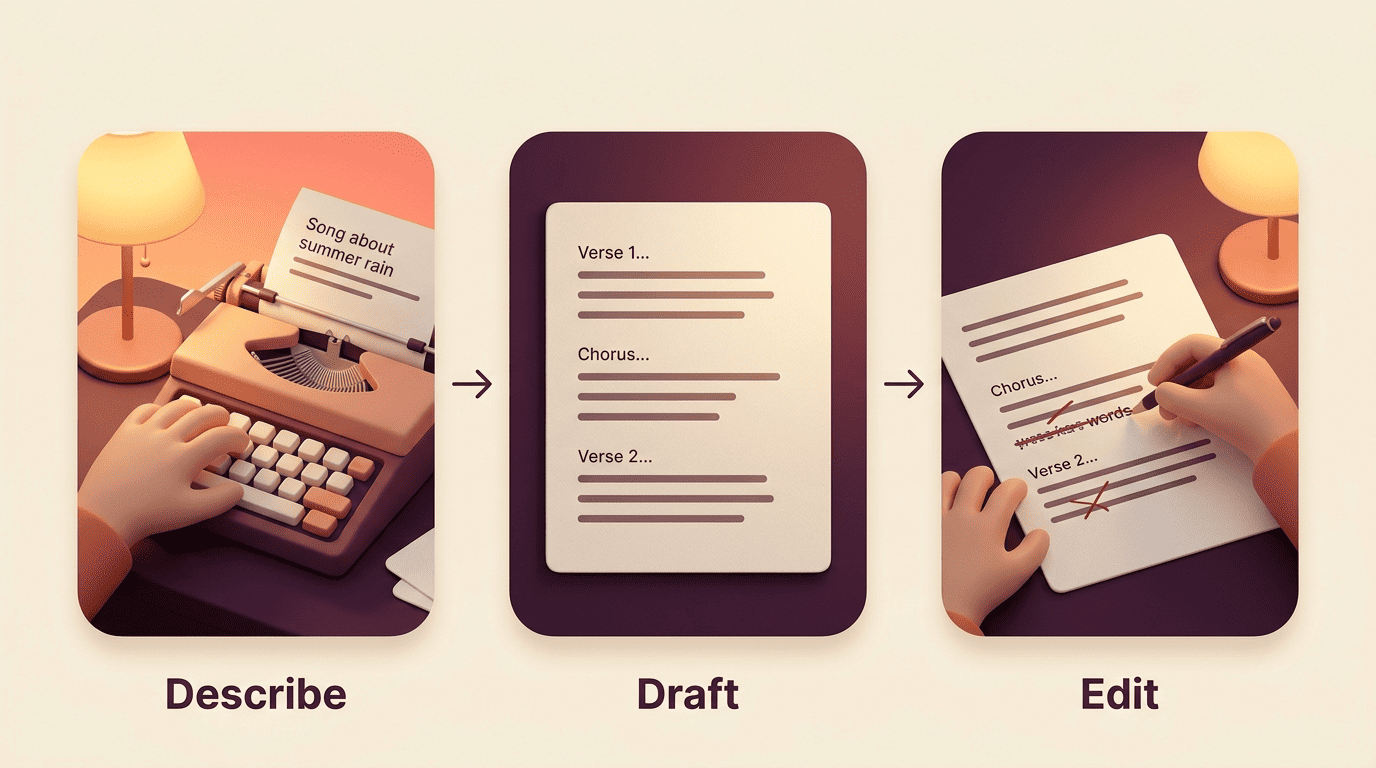
You give it a prompt, and the model predicts the next word, then the next, then the next — over and over — until the lines settle into the style, structure, and rhyme you asked for. In practice, the process breaks down into three simple steps:
- You describe the song — the topic, the genre, the feeling.
- The model drafts lines that fit that pattern, section by section.
- You edit the draft, cut what doesn’t sound like you, and make it yours.
Genres and Song Structure It Can Write
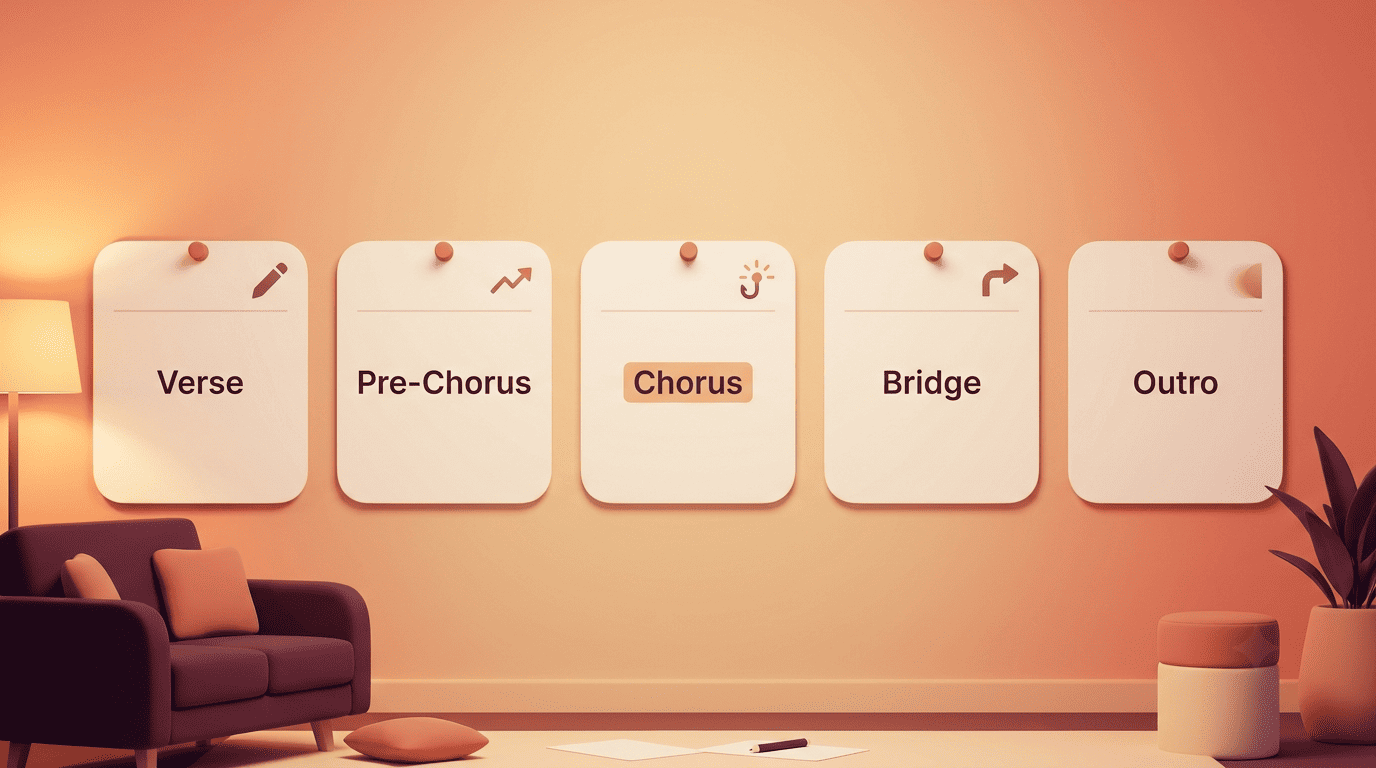
A lyric generator built for songwriters usually recognizes a wide spread of genres, and a full generation typically produces two verses plus a chorus and a bridge, ready for you to shape further. Underneath every genre sits the same skeleton of sections — verse, pre-chorus, chorus, bridge, hook, outro — arranged in different orders and different lengths depending on the style.
Song sections, explained
| Section | What it does | Tip |
|---|---|---|
| Verse | Tells the story — moves the narrative forward | Be specific and cinematic; one clear image beats three vague ones |
| Pre-chorus | Builds tension on the way into the chorus | Shorten your lines here to add urgency |
| Chorus | The emotional core of the song — carries the hook | Keep the hook short enough to sing back after one listen |
| Bridge | A turn — a new perspective right before the final chorus | Change the point of view or the tense to earn the shift |
| Outro | A soft landing for the song | Echo a phrase from the chorus instead of introducing something new |
Genres it adapts to
The genre you choose changes more than the topic — it reshapes the vocabulary, the rhythm, and even how long each line runs. An AI songwriting tool can typically adapt across:
- Pop
- Rock
- Rap / Hip-hop
- Country
- R&B
- EDM
- Gospel / Worship
- Folk / Indie
- K-pop
- Musical theatre
Rhyme, Rhythm, and Making Lines Sing
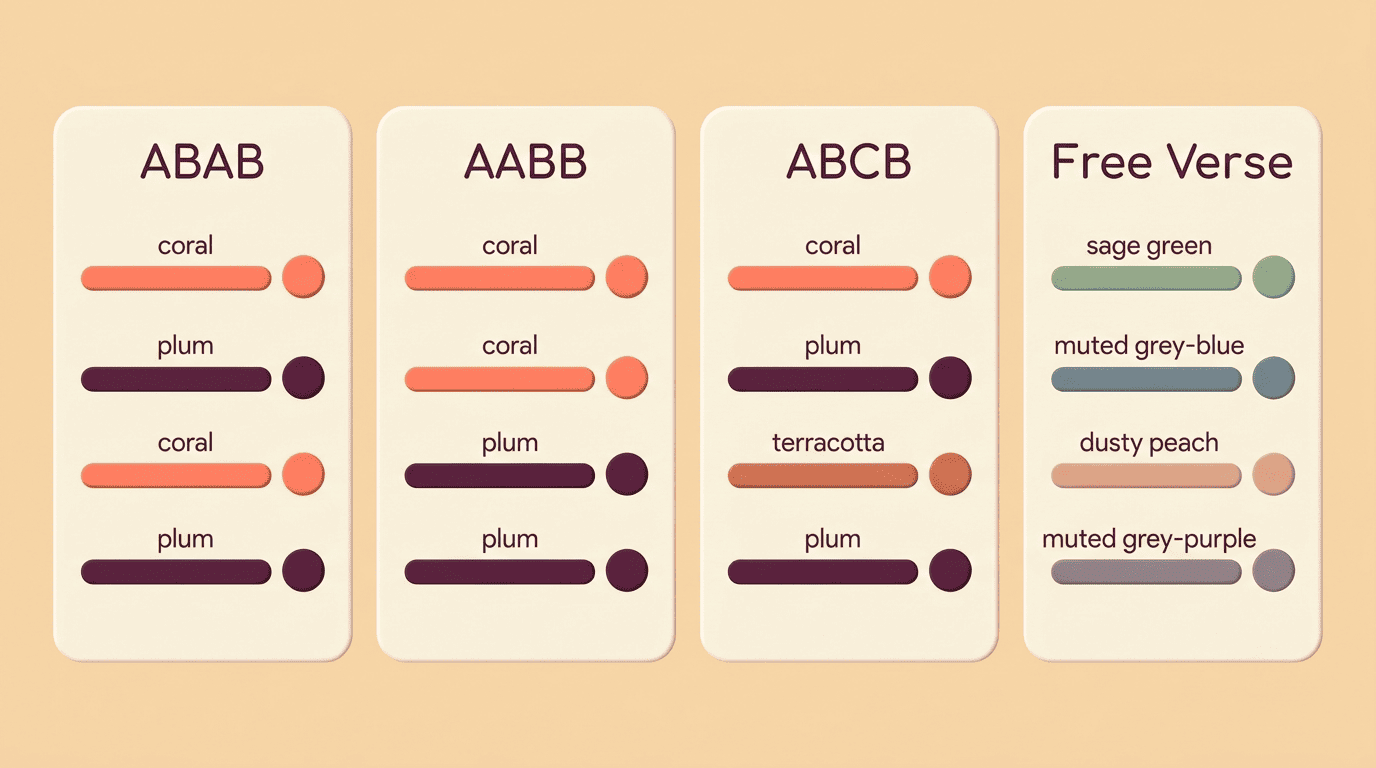
A lyric only really works once it’s sung out loud, which is why rhyme scheme and syllable count matter as much as the words themselves. Per Wikipedia’s entry on rhyme scheme, a rhyme scheme is simply the pattern of end rhymes across the lines of a verse — and different patterns carry very different moods. A good AI lyrics generator tracks both the rhyme pattern and the syllable count at once, so a line doesn’t just rhyme — it also fits the beat.
| Rhyme scheme | Pattern | Feels like / best for |
|---|---|---|
| ABAB | Alternating end rhymes | Pop, storytelling verses |
| AABB | Rhyming couplets | Playful, rap, kids’ songs |
| ABCB | Rhyme only on lines 2 and 4 | Ballads, folk, country |
| Free verse | No fixed rhyme pattern | Modern, indie, spoken word |
A few quick habits keep the prosody honest:
- Match stressed syllables to the beat, not just the words to the rhyme
- Keep the hook short — the shortest line usually lands hardest
- Read every draft out loud before you call it finished
How to Write a Great Prompt (So the Lyrics Feel Like Yours)
The prompt is where a generic draft turns into something that sounds like you. The more concrete detail you give — mood, genre, emotion — the more authentic the result comes back. Most tools let you enter up to three topics, up to three emotions, and a handful of keywords to anchor the whole thing.
The story or topic. What actually happened, or what you want the listener to picture — the more specific, the better the draft.
The genre. This sets the vocabulary, tempo, and structure before a single line is written.
The mood/emotion arc. Where the song starts emotionally, and where it ends up by the final chorus.
Point of view. Whether the song speaks as «I,» «you,» or «we» changes every line that follows.
A signature word or image. One concrete anchor — a place, an object, a phrase — gives the hook something to hold onto.
Any structure you want. For example, two verses plus a chorus and a bridge, spelled out up front. You can even name the rhyme scheme you want the AI to follow.
The difference shows immediately in the output. A weak prompt like «write a love song» comes back generic. A stronger one — «a hopeful indie-folk song about moving to a new city alone, first-person, warm but a little nervous, hook around the word ‘streetlights'» — comes back with a shape and a color you can actually work with.
Once the draft lands, edit like a songwriter:
- Cut the clichés first — they’re the easiest lines to spot
- Keep concrete images over abstract statements
- Sing it out loud before deciding it’s done
- Find the single best line and build the rest of the song around it
Owning Your Song: Originality and Copyright
Here’s the warm truth behind the legal language: use the AI as a co-writer, but write original lines — never copy lyrics from an existing, copyrighted song. Per the U.S. Copyright Office’s March 2023 guidance on AI, material generated by AI alone, with no human creative input, does not qualify for copyright protection — protection depends on genuine human authorship. The more you edit, select, and arrange the lines the AI hands you, the stronger your own authorship claim becomes.
For songwriters who want to go deeper on how authorship and ownership work in practice, the Songwriters Guild of America is a solid resource built specifically for writers, not just labels. Treat your ai songwriter the same way you’d treat any collaborator: a starting point for ideas, never a source to copy from word for word.
A few habits keep a song genuinely yours:
- Start from your own idea, not a borrowed one
- Replace generic lines with details only you would know
- Never reuse lyrics from an existing, released song
- Treat the AI draft as clay — something to reshape, not a finished piece
From Idea to Finished Song: A Simple Workflow
Turning a spark into a finished song usually follows the same rhythm, whether it’s your first song or your fiftieth. Here’s a simple seven-step workflow:
- Capture the spark — a line, an image, or a feeling you don’t want to lose.
- Pick a genre and a mood before you write a single word.
- Generate a first draft with an ai song writing tool.
- Read the draft twice and choose the strongest lines.
- Sharpen the hook until it’s short enough to sing back from memory.
- Fill the verses with concrete, specific images instead of generic ones.
- Sing the whole thing out loud, tweak the syllables that trip you up, and call it done.
The Songwriters Guild of America has stood behind writers for nearly a century, with a mission it states simply:
Protect Songwriters.
Songwriters Guild of America
That’s the whole spirit of writing with AI: the tool gives you momentum on the page, and you give the song its heart.