
AI Rhyme Generator: Find Perfect, Slant, and Internal Rhymes for Your Song
You’re humming a line, but the next one just won’t rhyme — sound familiar? That’s exactly where an AI rhyme generator earns its keep: a helper that scans your word or phrase and hands back dozens of matching sounds, in seconds, tuned to your mood and genre. Think of it as a co-writer’s dictionary that never gets tired, according to the Wikipedia entry on rhyme, which traces the device back through centuries of verse.
For an early boost, our ai song writer (Lyrivo) folds rhyme-finding, song structure, and lyric drafting into one workspace, so you’re not juggling three tabs mid-verse.
Below: what an AI rhyme generator actually is, the four rhyme types worth knowing, two rhyme schemes that shape a song’s feel, and a simple workflow to turn suggestions into lyrics that sound like you.
What Is an AI Rhyme Generator?
An AI rhyme generator is a tool that reads the sound and syllable pattern of a word or line and proposes matching words, phrases, or even full couplets. Under the hood, most run on a natural language processing (NLP) or transformer model that’s been fine-tuned on poetic structure — meter, stress patterns, and line flow — rather than on generic text prediction. That fine-tuning is what separates it from a plain rhyming dictionary: it reads context and mood, not just the last few letters of a word.
Older rhyming dictionaries only matched word endings, so «love» would just return «dove,» «above,» and «glove» with no sense of tone. A model trained on songwriting and lyrics can tell the difference between a tender ballad line and a defiant rap bar, and it shapes its suggestions accordingly.
This kind of tool is useful for a wide range of writers:
- Songwriters chasing a hook that won’t quite land
- Rappers building multisyllabic wordplay under a beat
- Poets exploring formal rhyme schemes
- Students learning how rhyme and meter fit together
- Jingle and ad copywriters on a deadline
- Anyone staring at a blank page, stuck on one stubborn line
How It Works (In Plain English)
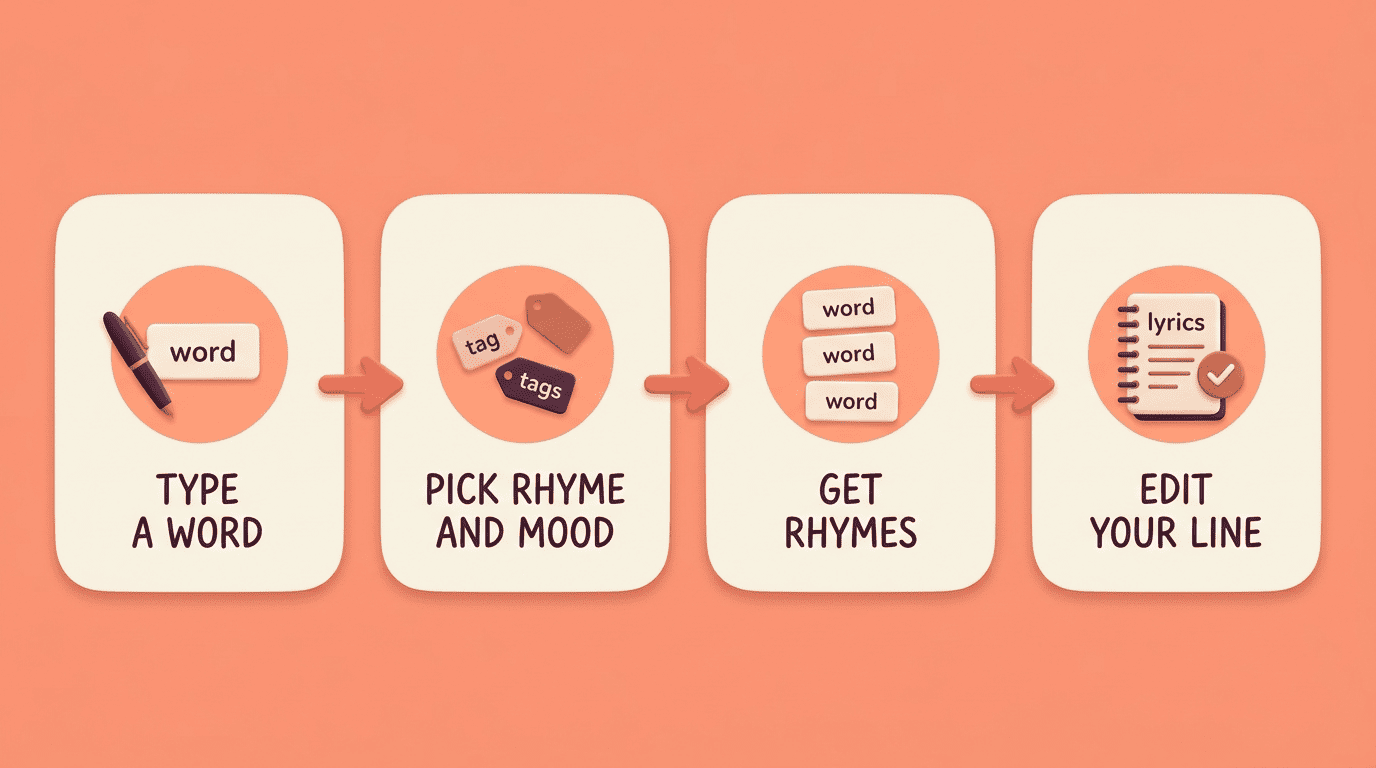
The process is short by design:
- Type in a word, phrase, or the line you’re stuck on.
- Choose a rhyme type, genre, and mood — romantic, funny, dark, or inspirational, for instance.
- Review the list of matching words and suggested lines.
- Edit and combine the results, keeping only what actually sounds like your voice.
Most tools also offer a «creativity» slider that pushes suggestions further from obvious matches, plus support for multisyllabic rhymes running five syllables or more. None of that replaces judgment — the model proposes, you decide what stays.
Rhyme is the repetition of similar sounds in two or more words, most often at the end of lines in poetry and song.
Wikipedia — Rhyme
The Main Types of Rhyme (and When to Use Each)
Rhyme isn’t just «cat» and «hat.» It spans a real spectrum — from tight, obvious matches to loose, textured near-misses — and an AI rhyme generator can produce examples of each on request.
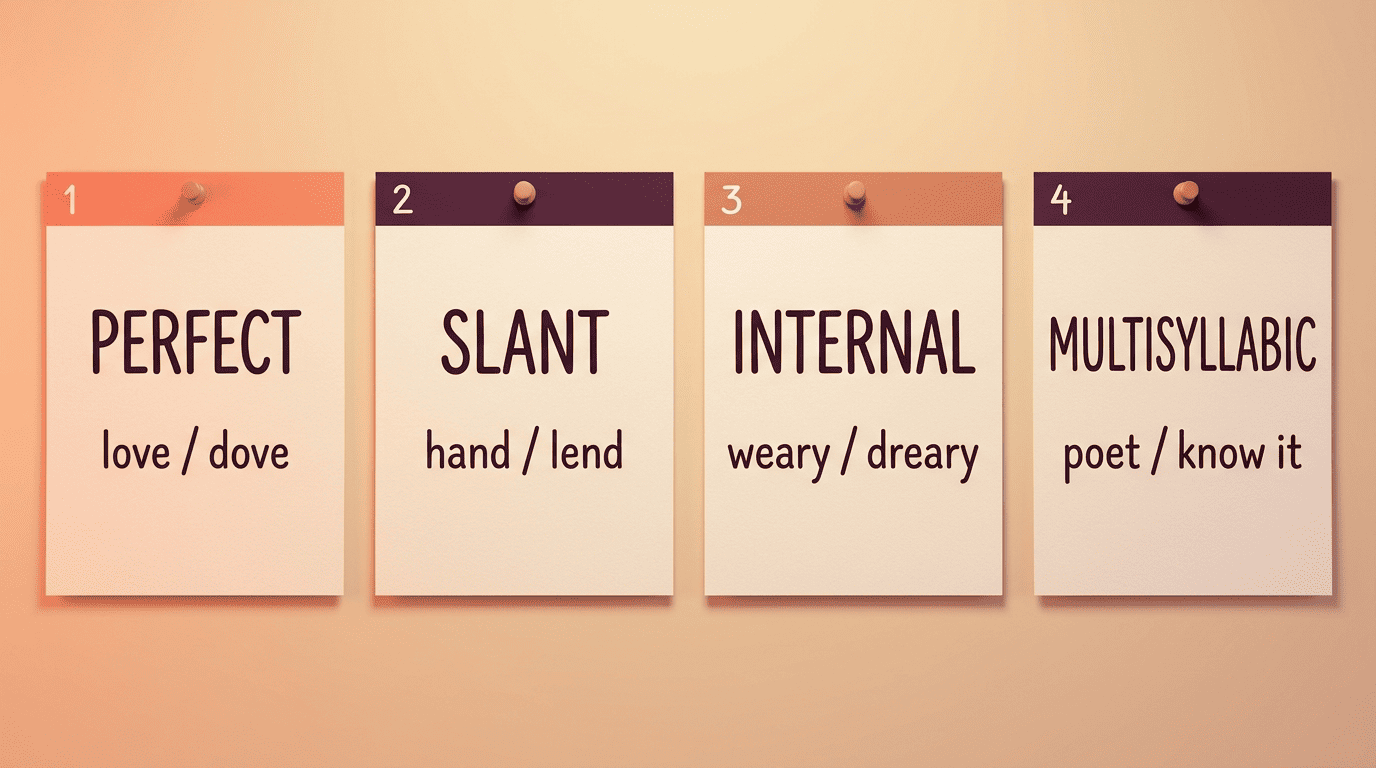
| Rhyme Type | What Matches | Example | Where It Shines |
|---|---|---|---|
| Perfect rhyme | Final stressed vowel and every sound after it | love / dove | Pop choruses, children’s songs |
| Slant (near) rhyme | Only the consonants or only the vowels | hand / lend | Indie, folk, modern rap |
| Internal rhyme | A word mid-line rhymes with the line’s end or another mid-line word | «I drove myself to the lake of fire» | Rap flow, fast verses |
| Multisyllabic rhyme | Two or more syllables rhyme, often across word boundaries | poet / know it | Hip-hop wordplay |
Perfect Rhyme
A perfect rhyme matches the final stressed vowel sound and everything that follows it — «love» and «dove,» «sight» and «flight.» Within perfect rhyme, there are recognizable subtypes: masculine rhyme, where the stress lands on the final syllable («rhyme» / «sublime»); feminine rhyme, stressed on the second-to-last syllable («picky» / «tricky»); and dactylic rhyme, stressed three syllables back («amorous» / «glamorous»). Perfect rhyme is the classic choice for pop choruses and children’s songs, because that exact, «satisfying» click of sound is instantly recognizable to a listener. You can see how the Poetry Foundation’s glossary defines and illustrates this baseline form.
Slant (Near) Rhyme
Slant rhyme — also called near rhyme or off rhyme — only partially matches sound. Half rhyme matches just the final consonants («hand» / «lend»), while true near rhyme pairs a stressed syllable with an unstressed one («wing» / «caring»). Two related devices sit close by: assonance, the repetition of vowel sounds («shake» / «hate»), and consonance, the repetition of consonant sounds («rabies» / «robbers»). Slant rhyme reads as more contemporary and less sing-song than perfect rhyme, which is why indie, folk, and rap writers lean on it — it avoids the nursery-rhyme feel that too much perfect rhyme can create. This is also where an AI rhyme generator earns its value most: it surfaces non-obvious near-rhymes a writer might not think to try.
Internal Rhyme
Internal rhyme places the rhyming sound inside a line rather than only at its end — a word in the middle of the line echoes the line’s final word, or echoes a word buried in a different line entirely. Edgar Allan Poe leaned heavily on this in «The Raven» («once upon a midnight dreary, while I pondered, weak and weary»), and the technique gives verse a driving, forward momentum. That’s exactly why it’s a staple of rap and any fast-paced verse: internal rhyme keeps the ear engaged between the big end-of-line payoffs.
Multisyllabic Rhyme
Multisyllabic rhyme — sometimes called mosaic rhyme — links two or more syllables at once, frequently crossing word boundaries: «poet» rhymes with «know it,» or «cover me» echoes «lover, see.» It’s a signature move of modern hip-hop, where stacking multisyllabic rhymes shows technical control and rewards close listening. Because the combinations multiply fast, this is another spot where an AI rhyme generator can outpace manual brainstorming — it can churn through dozens of multisyllabic pairings in the time it takes to think of one.
Rhyme Schemes: Giving Your Song a Shape
A rhyme scheme is a map of which lines rhyme with which, written out as letters — matching letters mean matching rhymes. It’s what sets a song’s pace and emotional feel before a single word is chosen, as the Wikipedia article on rhyme scheme lays out in detail.
| Scheme | How It Reads | Effect | Common In |
|---|---|---|---|
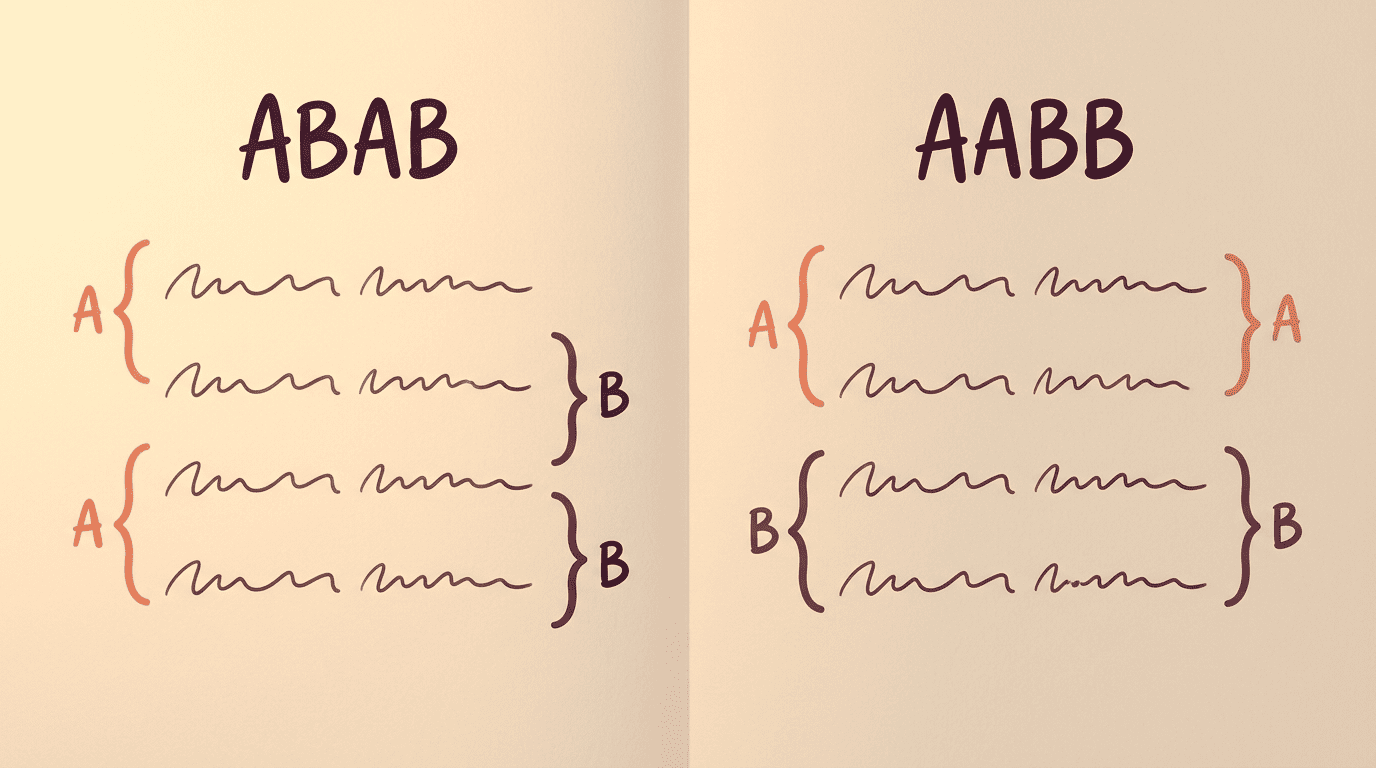
| ABAB | Lines 1 & 3 rhyme, lines 2 & 4 rhyme | Interlocking, forward motion | Pop and folk verses, Shakespearean sonnets |
| AABB | Lines 1 & 2 rhyme, lines 3 & 4 rhyme | Direct, punchy, memorable | Hooks, children’s songs, rap punchlines |
A few other schemes are worth knowing by name:
- ABCB — only the second and fourth lines rhyme, leaving more room for narrative detail
- AAAA (monorhyme) — every line shares one rhyme, driving a fast, insistent flow
- ABAB CDCD EFEF GG — the Shakespearean sonnet’s full 14-line pattern
- AABBA — the limerick’s five-line comic structure
ABAB — Alternate Rhyme
In an ABAB quatrain, the first and third lines rhyme with each other, and the second and fourth lines rhyme with each other — an alternating or «cross» rhyme pattern. It creates a sense of interlocking and movement across four lines rather than the closed feeling of a couplet, which is why it turns up so often in pop and folk verses. It’s also the backbone of the Shakespearean sonnet, whose 14 lines run ABAB CDCD EFEF GG.
AABB — Coupled Rhyme
AABB pairs lines directly: the first two lines rhyme, then the next two rhyme differently. Each couplet tends to land as one complete thought, resolved by the end of its second line. That directness makes AABB easy to remember and quick to write, which is exactly why hip-hop verses so often build in couplets, and why the classic limerick (AABBA) leans on the same punchy pairing for its comic timing.
How to Use an AI Rhyme Generator in Your Songwriting
Turning a list of rhyme suggestions into an actual verse takes a bit of process. A simple workflow:
- Pick the keyword or emotion at the center of the line you’re writing.
- Generate rhymes for that word, filtered by type and mood.
- Choose the rhyme type that fits your genre — perfect for a chorus, slant for something moodier.
- Arrange the chosen lines into your rhyme scheme.
- Read the verse aloud and trim anything that trips over itself.
A few habits make the results land better:
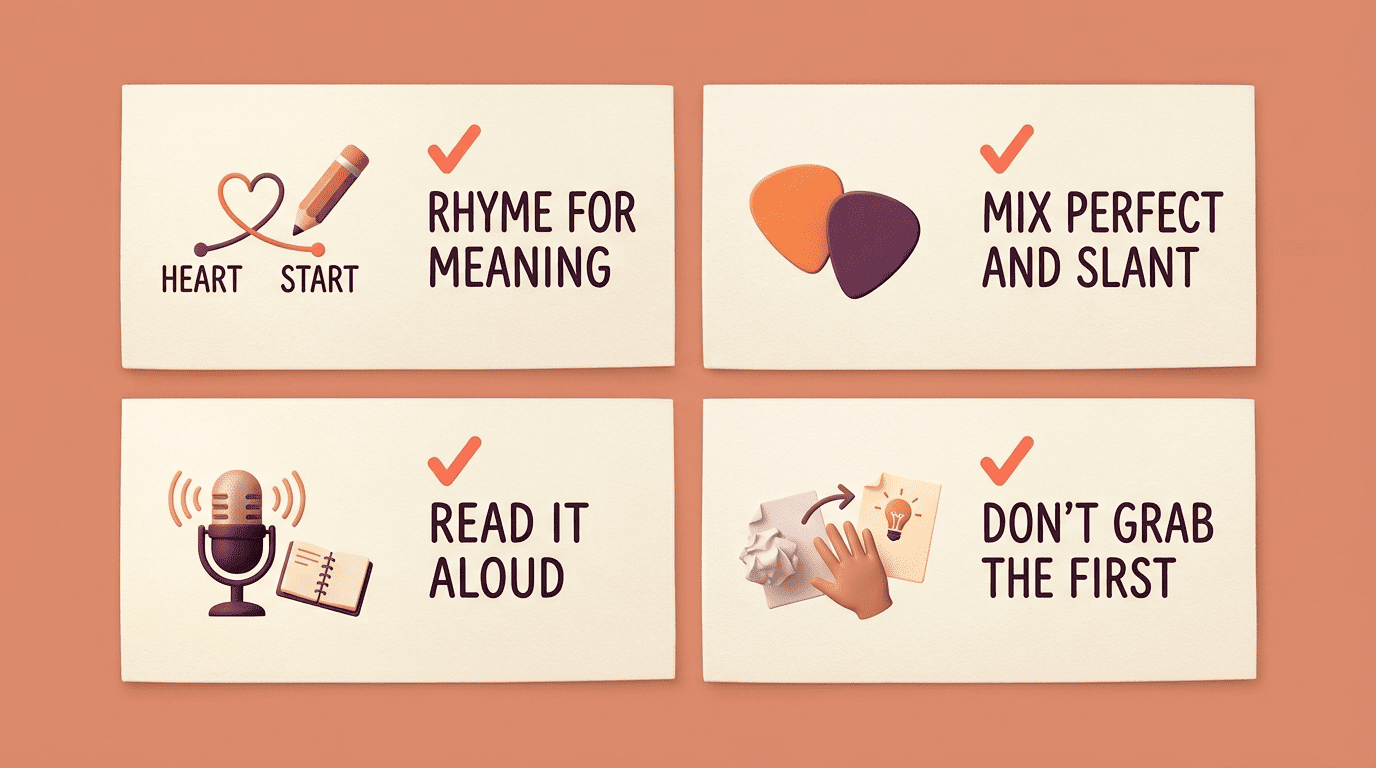
- Rhyme for meaning first, sound second — a rhyme that doesn’t fit the line’s idea will feel forced no matter how clean it sounds.
- Mix perfect and slant rhymes in the same verse instead of leaning on one type throughout.
- Read every line out loud; rhythm problems hide on the page and surface the moment you speak them.
- Don’t grab the first suggestion — scroll a few options down before settling.
Midway through a session, it helps to keep everything in one place: our ai songwriting assistant holds rhyme suggestions, song structure, and the lyric draft together, so a promising line doesn’t get lost between separate tools.
Matching Rhyme Type to Genre
- Pop — clean perfect rhymes in the chorus, for maximum sing-along recall
- Rap / hip-hop — multisyllabic and internal rhyme, to show technical range and keep flow moving
- Indie / folk — slant rhyme, for a more grown-up, less sing-song texture
- Country — narrative-driven couplets, often perfect rhyme, that push the story forward line by line
Writing Original Lyrics: A Gentle Note
An AI rhyme generator is there to widen your options, not to write the song for you. It’s worth pausing on that, gently: the tool can suggest a word, a line, even a whole couplet — but the song is still yours to steer, in your own voice, telling your own story. Use rhyme suggestions as a springboard, not a crutch you lean on for every line.
Most tools hand results back to you royalty-free, meaning you own what you write with them. But ownership of a line isn’t the same as originality of a song — write lyrics that are genuinely yours rather than echoing something you half-remember from another track. The rhymes are raw material; the meaning you bring is what actually makes a song a song.
That’s the spirit behind lyrivo ai songwriter too — a tool meant to speed up the mechanics of rhyme and structure, while the story stays entirely in your hands.