
AI Chorus Generator: How to Write a Chorus People Can’t Stop Singing
The chorus is the part of your song that sticks — the moment everyone sings back to you. An ai song writer like the one built into lyrivo helps you break the blank page, try a dozen hook angles in seconds, and shape a chorus that actually lands, drawing on the same principles music scholars use to describe what makes a hook work, as documented on Wikipedia.

But a tool only shines when you know what a great chorus is made of — repetition, a memorable hook line, and a lift out of the verse. This guide covers the craft first, then shows how to pair it with AI.
What an AI chorus generator actually does
An AI chorus generator takes your theme, genre, mood, and any existing lyrics and returns several distinct chorus variations to react to instead of one «correct» answer. You’re not looking for the tool to finish the song — you’re looking for a fast way to see five or six different angles on the same idea, so you can hear which one actually wants to be sung out loud.
From your idea to chorus options in seconds
Feed the generator a theme («summer breakup»), a genre (pop, country, R&B), and a mood, and it returns a handful of candidate choruses built around that repetitive, emotionally charged structure a chorus needs. Most tools also converge on a similar target length — somewhere around 20–24 seconds is the sweet spot for a chorus that’s long enough to feel like a payoff but short enough to stay memorable across three or four repeats in a three-minute song.
Where it helps most
An AI chorus generator earns its keep in a few specific situations:
- Beating writer’s block — when the verse is finished but the hook line won’t come, generating options gives you something to react to instead of a blank cursor.
- Testing multiple hook angles fast — comparing five phrasings of the same idea side by side is faster than drafting each by hand.
- Keeping genre voice consistent — pop, rap, country, and worship choruses each lean on different vocabulary and cadence, and a genre-aware generator adjusts for that automatically.
- Working from clarifying prompts — the better tools ask about theme, tempo, and mood before generating, so the output already fits your track instead of needing a rewrite.
- Producing usable draft length — expect roughly 4–8 lines back, tuned for flow, internal rhyme, and one central hook line to build the rest of the section around.
What makes a chorus catchy
A chorus earns its stickiness from three overlapping ingredients: repetition, a strong hook line, and a moment that peaks above everything around it.
Repetition is the engine
Choruses repeat both musically and lyrically — that repetition is what turns a line from «clever» into «singable.» Keep the central line short and repeatable: hooks are usually one or two lines lasting 4–8 bars, because long, complex lines are hard for a listener to remember and even harder for them to sing back after one listen.
The hook line — your «money note» moment
Per Wikipedia, a hook is «a musical idea, often a short riff, passage, or phrase, that is used to make a song appealing and to catch the ear of the listener,» and it «is often found in, or consists of, the chorus,» as detailed in the Wikipedia entry on hooks. Songwriting craft adds a related idea: the «money note» — the higher-pitched or longer-held note that grabs full attention right as the hook lands. It’s the note an audience waits for, and it sits inside the chorus’s high point roughly 95% of the time.
A hook is the capstone of a well-crafted song. It’s part melody, part lyric, and most likely it’s both.
Andrea Stolpe, Berklee College of Music
Emotion, prosody, and simplicity
Great hooks say no more and no less than necessary. Prosody — how well the words fit the melody’s rhythm and stress — matters as much as clever wordplay; a technically brilliant line that fights the melody will lose to a simple line that rides it. When you’re comparing AI-generated chorus options, read them out loud against the beat before judging them on the page.
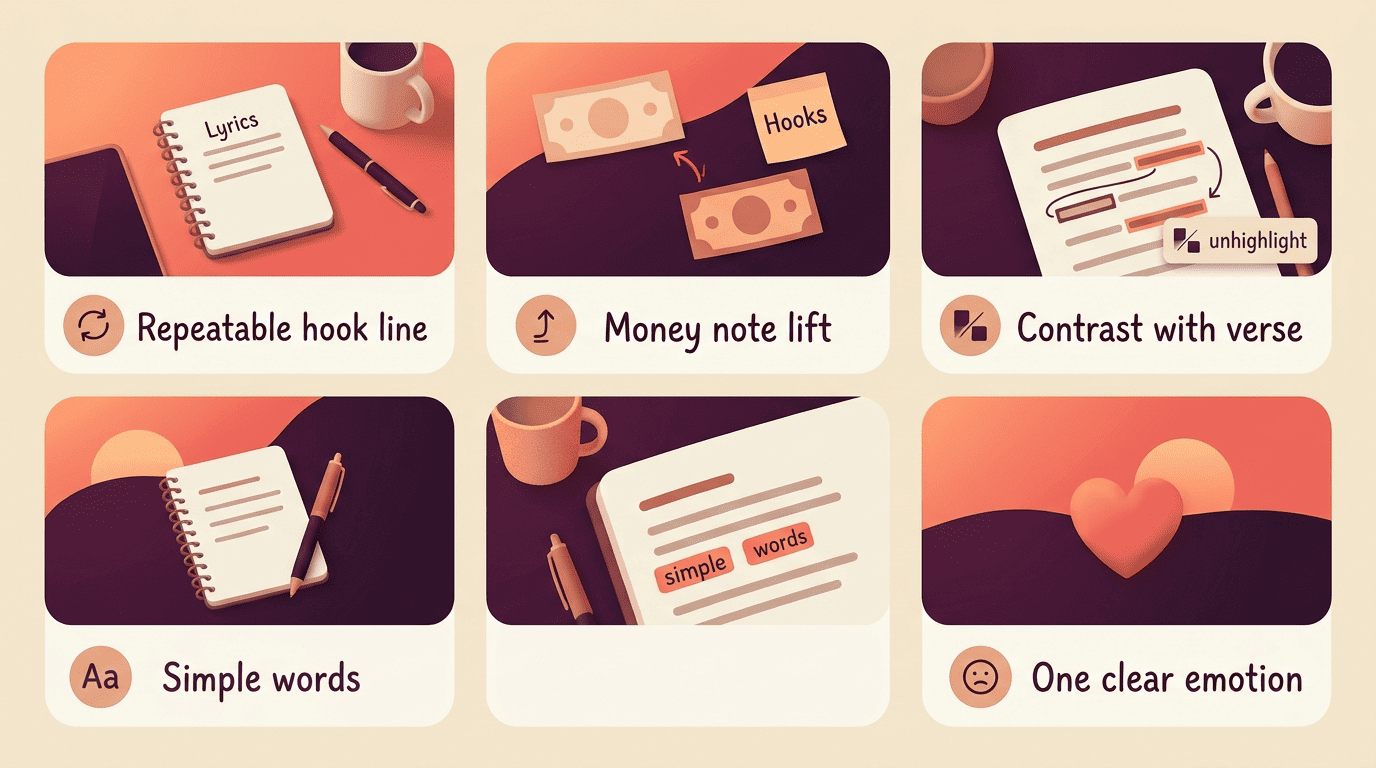
Five traits show up again and again in choruses that stick:
- A short, repeatable hook line — one or two lines, not a paragraph.
- A melodic lift near the money note, so the highest or longest note lands on the most important word.
- Real contrast with the verse in rhythm, range, and dynamics.
- Simple, concrete language over clever wordplay that’s hard to sing back.
- A clear emotional core — one feeling, stated plainly, not three ideas competing for space.
Hook vs. chorus vs. refrain
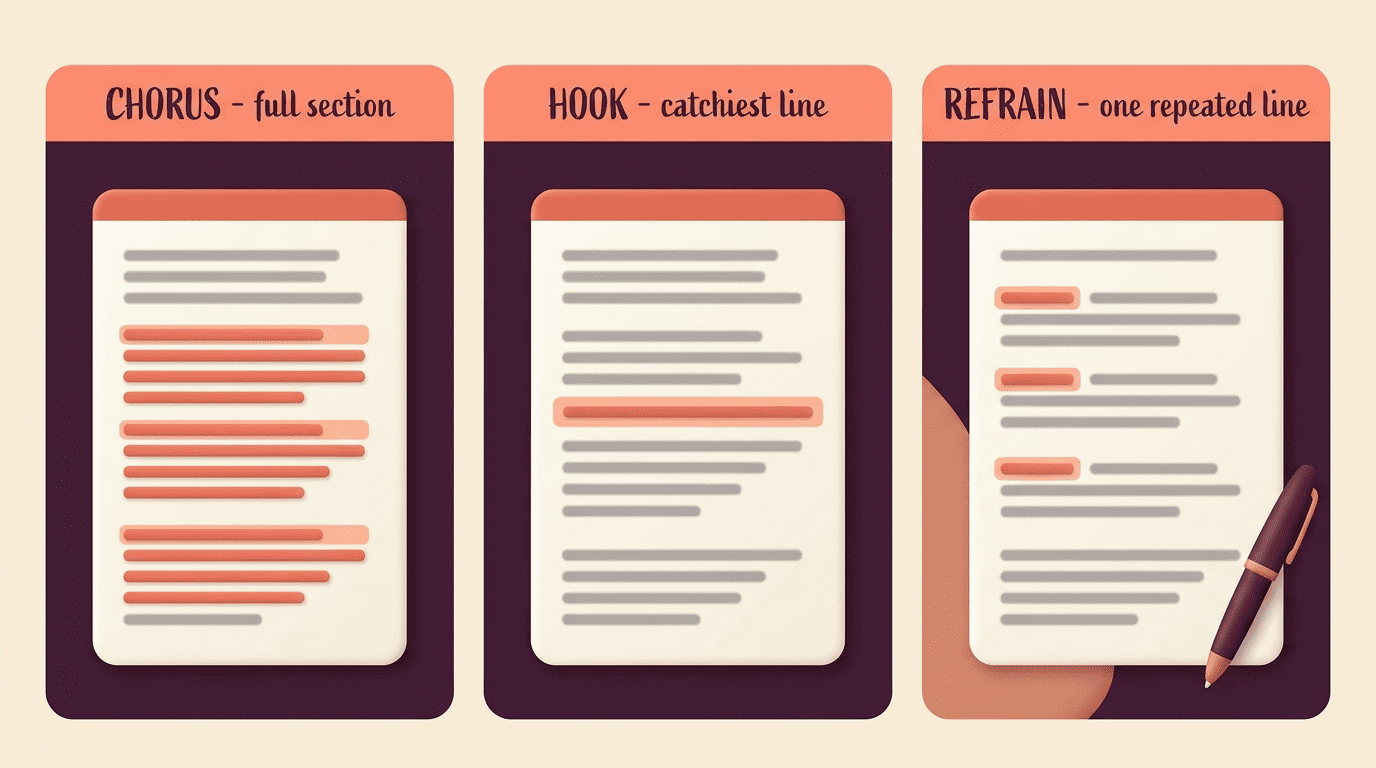
These three terms get used interchangeably, but they describe different things — and knowing which one you’re asking an AI for changes the prompt you should write.
| Term | What it is | Typical length | Where it lives |
|---|---|---|---|
| Chorus | The full, repeating section of the song | 20–24 seconds | Recurs after each verse |
| Hook | The single catchiest fragment inside a section | 1–2 lines / 4–8 bars | Usually inside the chorus |
| Refrain | A repeated line, often the title, that returns at set points | One line | Often closes a verse, per Wikipedia’s entry on refrains |
They overlap but aren’t the same
The chorus is a full, repeating section built around a theme; the hook is the catchiest fragment inside it; the refrain is a repeated line — often the title — that can live at the end of a verse rather than in a separate section at all.
Why the distinction matters when you generate
Ask an AI chorus generator for a «hook» and you’ll typically get back one punchy line. Ask it for a «chorus» and you’ll get the whole section — verse-length, with internal structure. Being specific about which one you need keeps the output usable instead of forcing you to trim a full section down to a single line, or pad one line out into four. A quick way to keep prompts sharp:
- Ask for a hook when you already have a chorus melody and just need the title line or the money-note phrase.
- Ask for a chorus when you need the full section — hook plus supporting lines — built around a theme.
- Ask for a refrain when you want a single repeated line that can close out each verse instead of launching a separate section.
Lifting the chorus out of the verse
A chorus that sounds like the verse just got louder isn’t lifting — it’s just repeating. The lift comes from real contrast.
Contrast is what makes it feel like a chorus
According to the structural conventions documented on Wikipedia’s song structure page, the chorus should contrast with the verse melodically, rhythmically, and harmonically, and it typically sits at a higher level of musical and emotional intensity than the verse around it. In practice, that means keeping the verse’s melody in a narrow 3–4 note range so the chorus has somewhere to go — if the verse already uses the full range, the chorus has nowhere left to climb.

Setup and payoff
Treat verse and chorus as tension and release: the verse builds the question, and the hook is the answer. As Berklee’s Andrea Stolpe puts it, «a musical hook stands out from the section that came directly before it» — which is really a description of contrast, not volume. A quieter, sparser verse can set up a chorus just as effectively as a loud one, as long as something changes when the chorus arrives.
A chorus is probably missing its lift if:
- It uses roughly the same melodic range as the verse before it.
- The rhythm of the vocal line barely changes between sections.
- Nothing gets louder, higher, or more open when the chorus starts.
- The hook line reads the same in energy as the line right before it.
Placement and song structure
Even a strong chorus underperforms if it lands in the wrong spot. Structure decides how often — and how soon — the listener gets to hear it.
A common modern form. Intro → verse → pre-chorus → chorus → verse → pre-chorus → chorus → bridge → chorus is the shape behind a large share of contemporary pop and country radio songs, because it gets to the hook fast and repeats it enough times to lodge in memory.
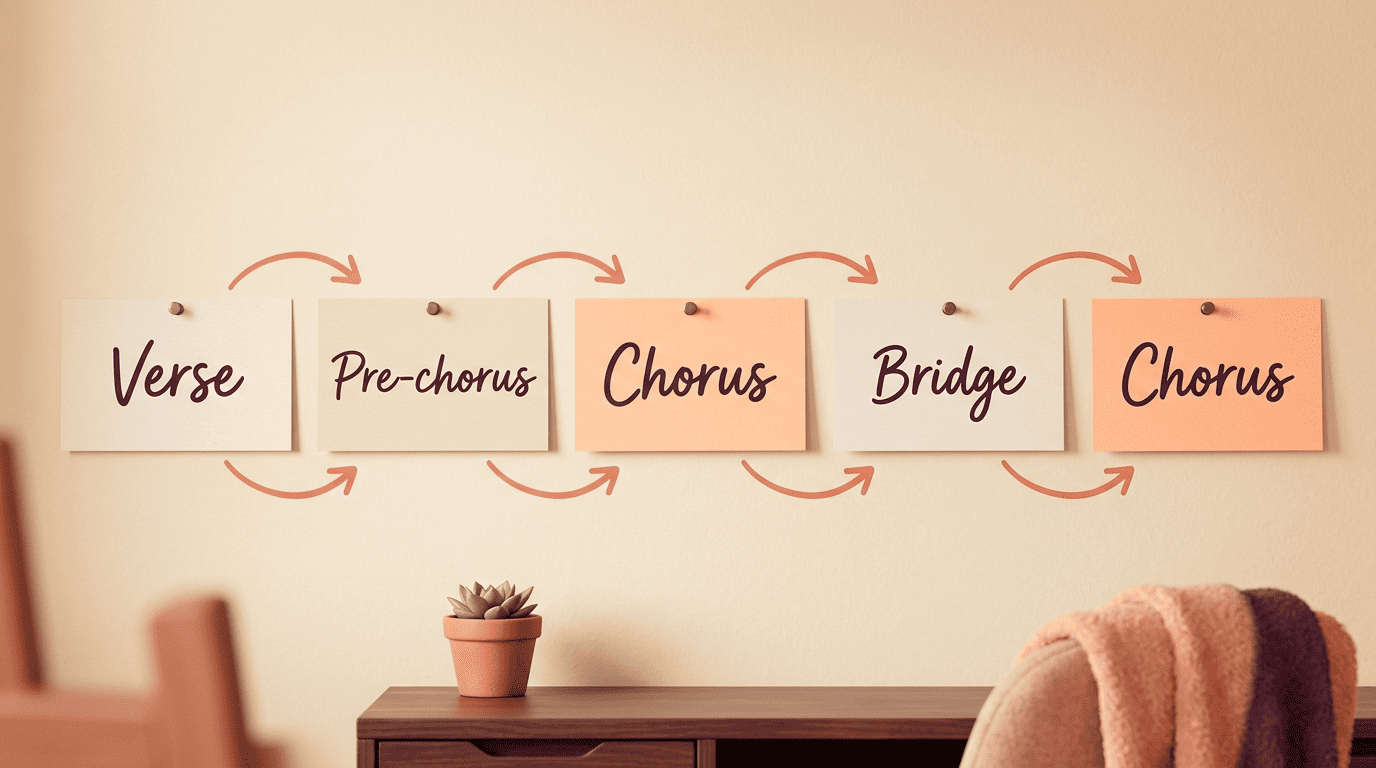
The pre-chorus does connective work. It bridges the verse to the chorus and raises anticipation, often by holding on a chord that leans toward the coming section rather than resolving — that unresolved feeling is what makes the chorus’s arrival feel earned instead of arbitrary.
Repeat, but don’t bore. Come back to the chorus at least twice more after its first appearance, but let the final repeat lift higher — a vocal ad-lib, a stacked harmony, or a key change — so repetition rewards the listener instead of wearing them down.
| Section | Role | Typical placement |
|---|---|---|
| Verse | Tells the story, narrow melodic range | 1st and 2nd sections |
| Pre-chorus | Raises anticipation, connects verse to chorus | Between verse and chorus |
| Chorus | Delivers the hook, widest range and most energy | Repeats 3+ times |
| Bridge | Breaks the pattern before the final chorus | Late in the song, before the last chorus |
Writing your chorus with AI — a simple workflow
Pairing craft knowledge with a generator works best as a short, repeatable process rather than a one-shot prompt.
- Identify the emotional core. Name the single feeling the chorus needs to land — not the whole song’s story, just this one moment.
- Set genre and mood. Tell the tool the genre and emotional tone up front so the vocabulary and cadence match your track from the first draft.
- Paste your verse for context. Giving the generator your verse lyrics lets it write a chorus that contrasts with what’s already there instead of repeating it.
- Generate several choruses. Ask for multiple variations rather than settling on the first result — comparing options is where the tool adds the most value.
- Keep the strongest hook line and refine. Pull the one line that’s already working, then hand-edit the wording and rhythm around it until it scans naturally when sung.
Keep it yours
Use AI to spark and shape a first draft, then rewrite the wording in your own voice — the goal is original lyrics that carry your specific images and phrasing, not a rework of a line you half-remember from an existing song. Treat any AI output the same way you’d treat your own rough draft: a starting point to revise, not a finished lyric to ship untouched.