
AI Song Structure Generator: Map Your Verse, Chorus, and Bridge with Confidence
Staring at a blank page with a melody in your head but no idea where the verse should end and the chorus should hit is one of the most common blocks in songwriting. It feels like every song is a mystery you have to solve from scratch. It isn’t — nearly every song you love, from a folk ballad to a stadium anthem, rides a repeatable skeleton, and an ai song writer can hand you that skeleton before you write a single lyric.
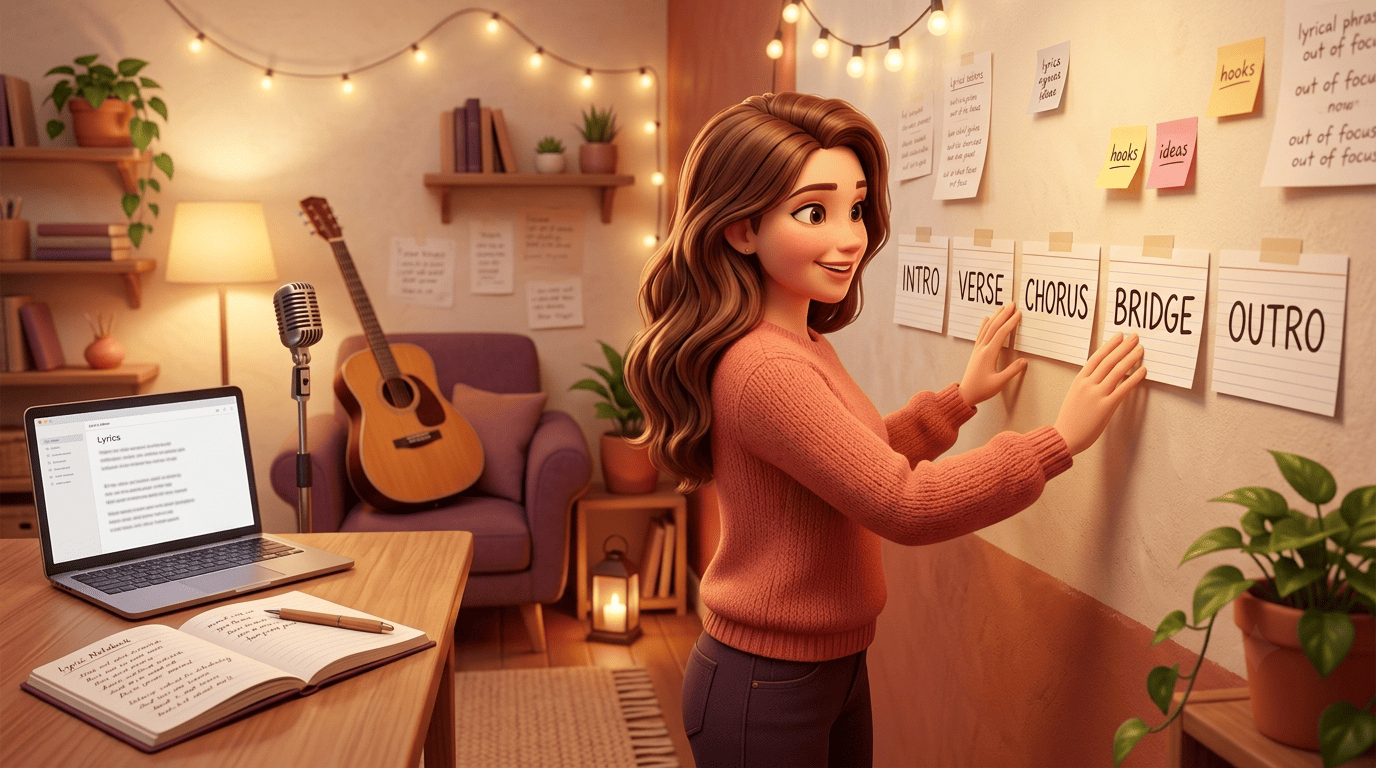
An AI song structure generator is a tool that lays out the sections of a song — intro, verse, pre-chorus, chorus, bridge, outro — arranged by genre, mood, and theme, so you always know what comes next. It leans on the same song structure patterns that professional writers have used for decades, then hands you a personalized map in seconds instead of hours.
What a Song Structure Generator Actually Does
Think of it as a song map, or a blueprint pinned to the wall — the kind a screenwriter uses for a plot, except the «scenes» are your intro, verses, and chorus. You feed it inputs like genre, mood, theme, and rough tempo or BPM, and it returns an ordered list of sections with suggested lengths. The point isn’t to hand you a finished song. It’s to remove blank-page paralysis and give you guardrails and momentum so you can focus on the words and melody instead of wondering what section comes after the second verse. A good generator draws from common patterns like verse-chorus-bridge while leaving plenty of room to experiment, cut a section, or add one that doesn’t usually belong.
Most generators ask for a handful of simple inputs before they build your map:
- Genre (pop, country, hip-hop, EDM, folk, and so on)
- Mood (hopeful, melancholic, anthemic, laid-back)
- Theme or subject (what the song is actually about)
- Rough tempo or BPM
- Preferred song length or section count
From a loose idea to an ordered map
Say you type in «hopeful indie-pop breakup song.» A structure generator might return: Intro → Verse 1 → Pre-Chorus → Chorus → Verse 2 → Pre-Chorus → Chorus → Bridge → Final Chorus → Outro. Nothing about your idea, your story, or your voice has changed — you keep the words, the tool just keeps the shape, so you’re never wondering what comes next while you write.
Why structure matters
A structure works like a blueprint: it gives a song guardrails and momentum at the same time. Good sections build and release tension in turn, so a listener stays engaged from the first line to the last chorus, and each section should naturally lead into the one after it rather than feeling bolted on. Structure is ultimately what separates a song that feels finished from a pile of good lines that never quite land.
The Building Blocks: Every Section and Its Job
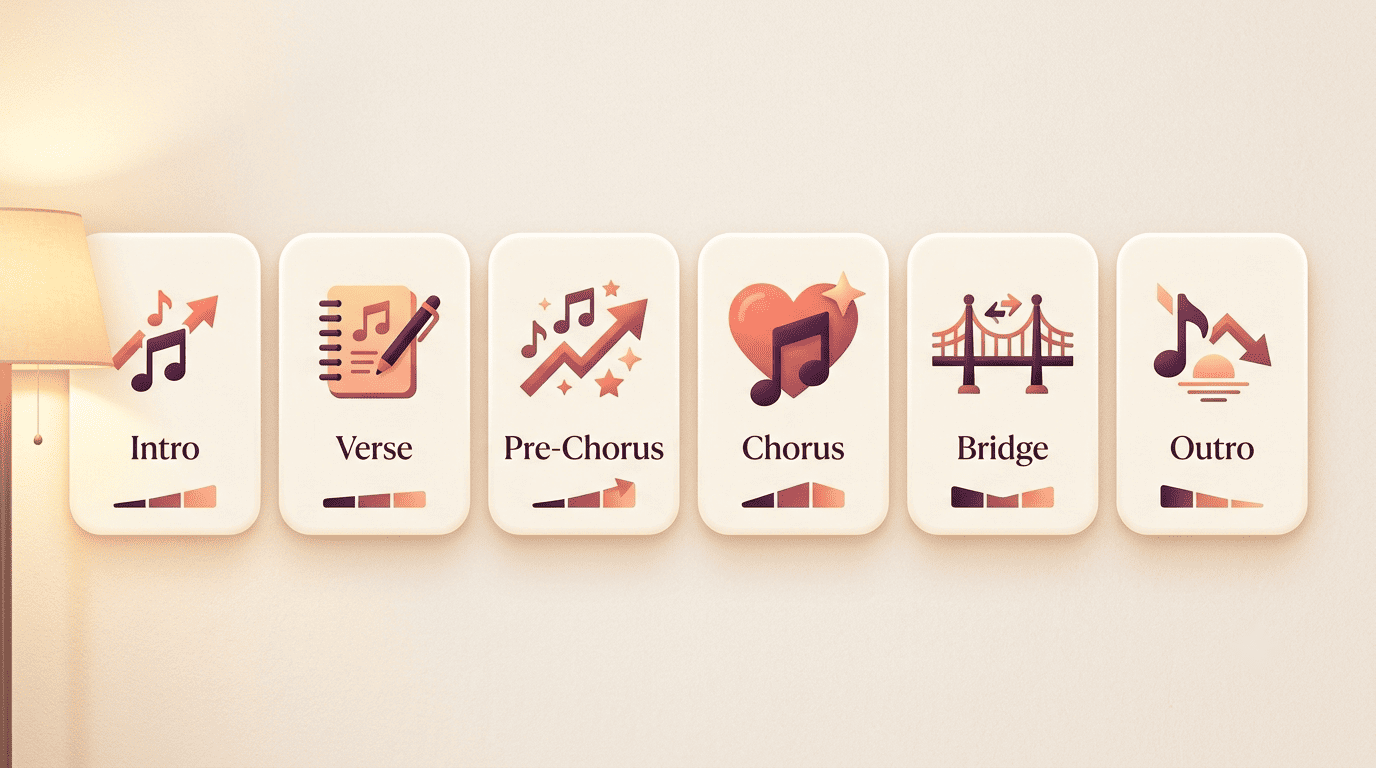
Every song form is built from the same handful of parts, and each one has a specific job to do. Knowing these roles is what makes a structure generator’s output make sense instead of feeling like a random list of labels.
| Section | What it does | Typical energy |
|---|---|---|
| Intro | Sets the mood and builds anticipation before the story starts | Low, rising |
| Verse | Tells the story; new lyrics each time over a repeated melody, usually 8-12 bars | Low to medium |
| Pre-chorus | Climbs and builds tension heading into the chorus | Rising |
| Chorus | The highest-energy payoff; holds the hook, lyrics repeat unchanged | High |
| Post-chorus | A hooky chant that sustains energy after the chorus | High |
| Bridge | Contrasts with the rest of the song, often starting off the tonic | Varies, often a dip or lift |
| Outro / coda | Winds the song down, often via a fade-out | Low, falling |
Verse vs. chorus — the core distinction
The verse and the chorus are the two pillars everything else hangs off, and the difference between them explains most of pop songwriting in one rule. When the verse’s music returns, it gets new lyrics — you’re moving the story forward each time. The chorus, by contrast, usually keeps identical lyrics every time it repeats, which is exactly what makes it stick in a listener’s head. That’s also where the hook lives: the main idea of the song, delivered the same way each time so it becomes unmistakable.
The bridge and the hook
The bridge exists to contrast and offer a new perspective right before the final chorus lands. Many bridges shift key or open on a chord that isn’t the tonic, which is part of why they feel like a break from everything that came before — a breath before the song’s biggest moment. The hook, meanwhile, is the memorable phrase the whole chorus is built to deliver; songwriters sometimes call the bridge the «middle eight,» a term borrowed from the eight-bar contrasting section common in older popular song forms — see Bridge (music) for the full background.
Common Song Forms, Explained
Most songs fall into one of a handful of recognizable forms, and knowing them by name makes it much easier to tell a generator what you actually want.
| Form | Pattern | Where you hear it | Example song |
|---|---|---|---|
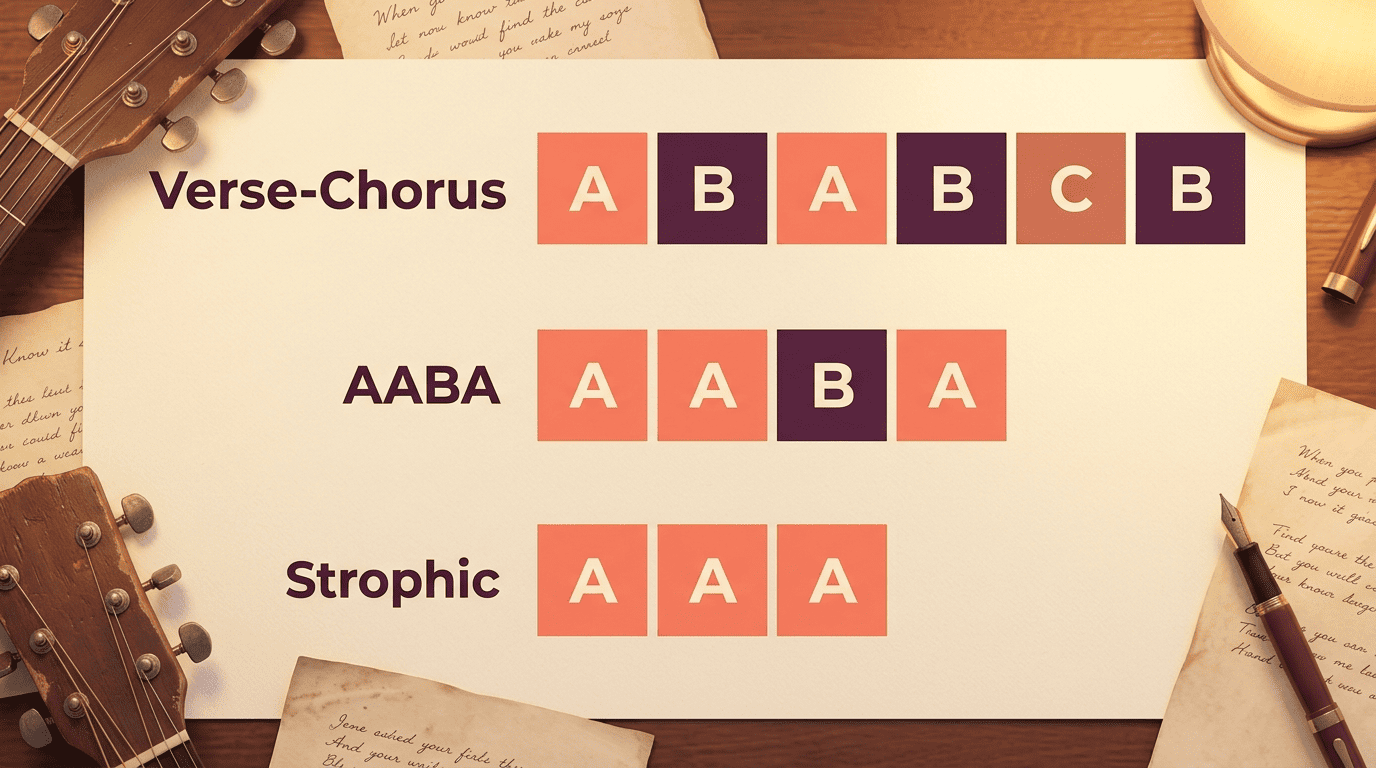
| Verse-chorus (ABABCB) | Verse–Chorus–Verse–Chorus–Bridge–Chorus | Pop, rock, R&B, country | «Shape of You» (Ed Sheeran) |
| Verse-chorus (ABAB) | Verse–Chorus–Verse–Chorus | Simpler, shorter songs | «Back in Black» (AC/DC) |
| AABA (32-bar) | Verse–Verse–Bridge–Verse | Jazz standards, ballads | «Yesterday» (The Beatles) |
| Strophic (AAA) | Repeated verse with a refrain line | Folk, storytelling | «The Times They Are a-Changin'» (Bob Dylan) |
| 12-bar blues | Fixed 12-bar chord cycle | Blues, early rock | «The Thrill Is Gone» (B.B. King) |
| Through-composed | No repeating sections | Art song, cinematic scoring | — |
For a deeper dive into any of these, verse-chorus form, the 32-bar form, and 12-bar blues each have their own history and variations worth exploring on Wikipedia.
The workhorse: verse-chorus (ABABCB)
The most common modern format runs intro, verse, pre-chorus, chorus, verse, pre-chorus, chorus, bridge, chorus. This ABABCB pattern is often described as the single most common song structure in modern commercial music, and for good reason — it balances a strong narrative with a payoff you can sing along to well before the song ends. It’s also the safe default an AI generator will typically suggest first if you don’t specify otherwise, since it works across genres and rarely feels out of place.
AABA and the older forms
AABA is four roughly 8-bar sections — two verses, a bridge, and a final verse — adding up to 32 bars total. It’s the backbone of jazz standards and mid-century ballads, built for melodies that need room to breathe without a hook-driven chorus interrupting them. Strophic, or AAA form, repeats one verse melody over and over with a refrain line woven in — the shape you hear across folk songs and hymns, where the story matters more than a repeated chorus. Twelve-bar blues locks into a fixed harmonic cycle instead of a section pattern at all. Knowing these older forms gives a structure generator far more colors to work with than pop alone.
Song Maps by Genre
Different genres lean on different maps, and a good generator adjusts its output depending on which one you tell it you’re writing in. An ai songwriting assistant can generate any of these on demand for your exact brief — genre, mood, and theme all included.
- Modern pop: Intro → Verse → Pre-Chorus → Chorus → Post-Chorus → Verse → Bridge → Chorus + Post-Chorus outro
- Modern country: Intro → Verse 1 → Pre-Chorus → Chorus → Verse 2 → Pre-Chorus → Chorus → Bridge → Double Chorus → Outro
- Storytelling ballad (AABA): Verse 1 → Verse 2 → Bridge → Verse 3 → Optional tag
- Hip-hop/rap: Intro → Hook → Verse 1 → Hook → Verse 2 → Hook → Bridge → Hook
- EDM/dance: Intro → Build → Drop → Breakdown → Build → Drop → Outro
In EDM, «the drop» effectively replaces the traditional chorus as the song’s release point — it’s where the tension the build-up created finally pays off. It’s also worth noting that contemporary pop often shortens or skips the intro entirely, jumping straight into the hook to grab a listener’s attention in the first few seconds.
Dynamics: Building the Energy Curve
A song isn’t a flat line — it’s an energy curve, and structure is the tool that shapes it. Verses tend to sit lower and more conversational, giving the listener room to follow the story. The pre-chorus climbs from there, building tension on purpose. The chorus is the peak, the release the whole section was building toward. The bridge then dips or turns in a different direction to create contrast, which is exactly what makes the final chorus land harder than the ones before it.
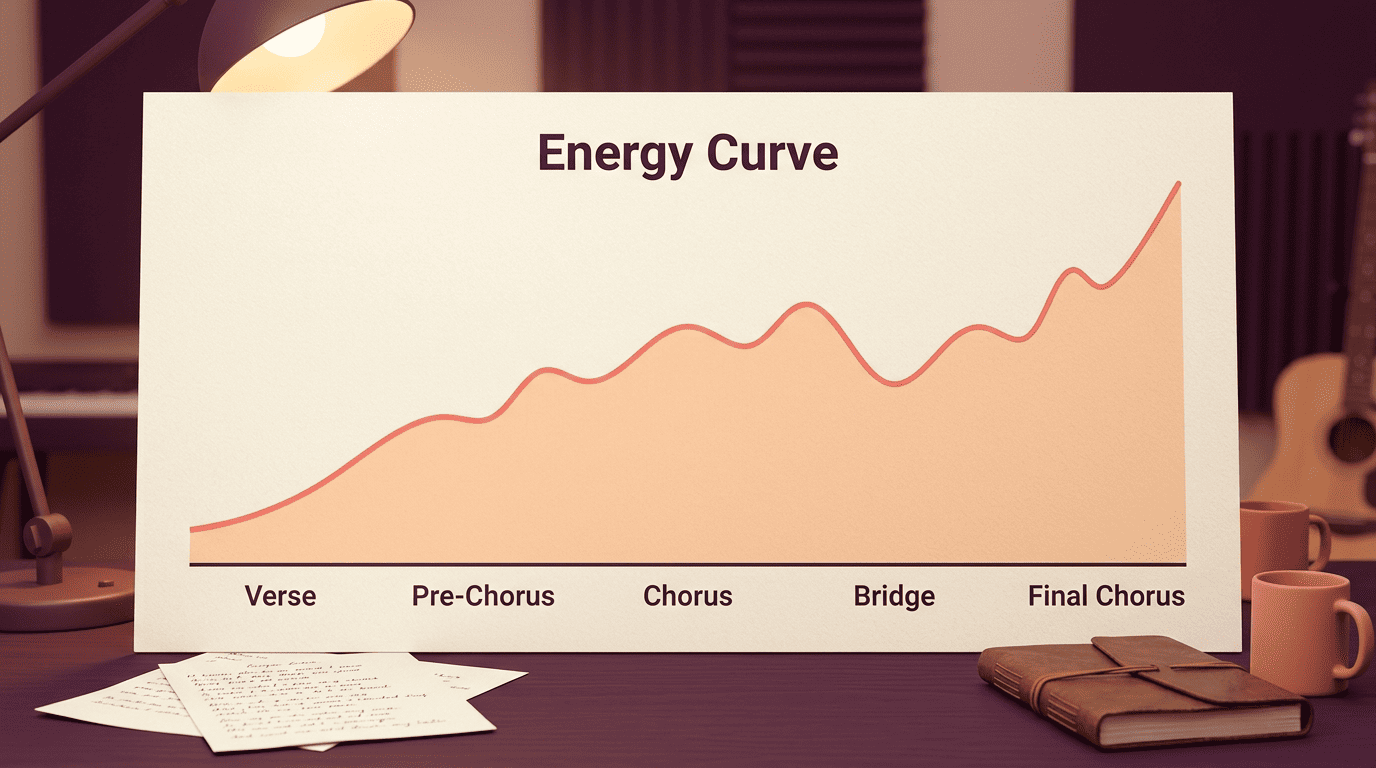
A few practical ways to shape that curve:
- Add or remove instrumental layers between sections to signal a shift in energy
- Keep the outro concise rather than letting it drag past the emotional peak
- Avoid repeating the chorus so many times it starts to feel formulaic
- Use the bridge deliberately as a dip or a key change, not just a placeholder section
- Let the pre-chorus do real work — it should feel like tension building, not a pause
Structure ultimately controls where a listener feels the biggest emotional lift in your song, and that’s not an accident — it’s a decision you can make on purpose. The ABABCB pattern earns its place as the default precisely because it’s built to deliver that lift more than once.
In verse–chorus form the chorus is highlighted (prepared and contrasted with the verse).
Verse–chorus form — Wikipedia
How to Use an AI Song Structure Generator (Step by Step)
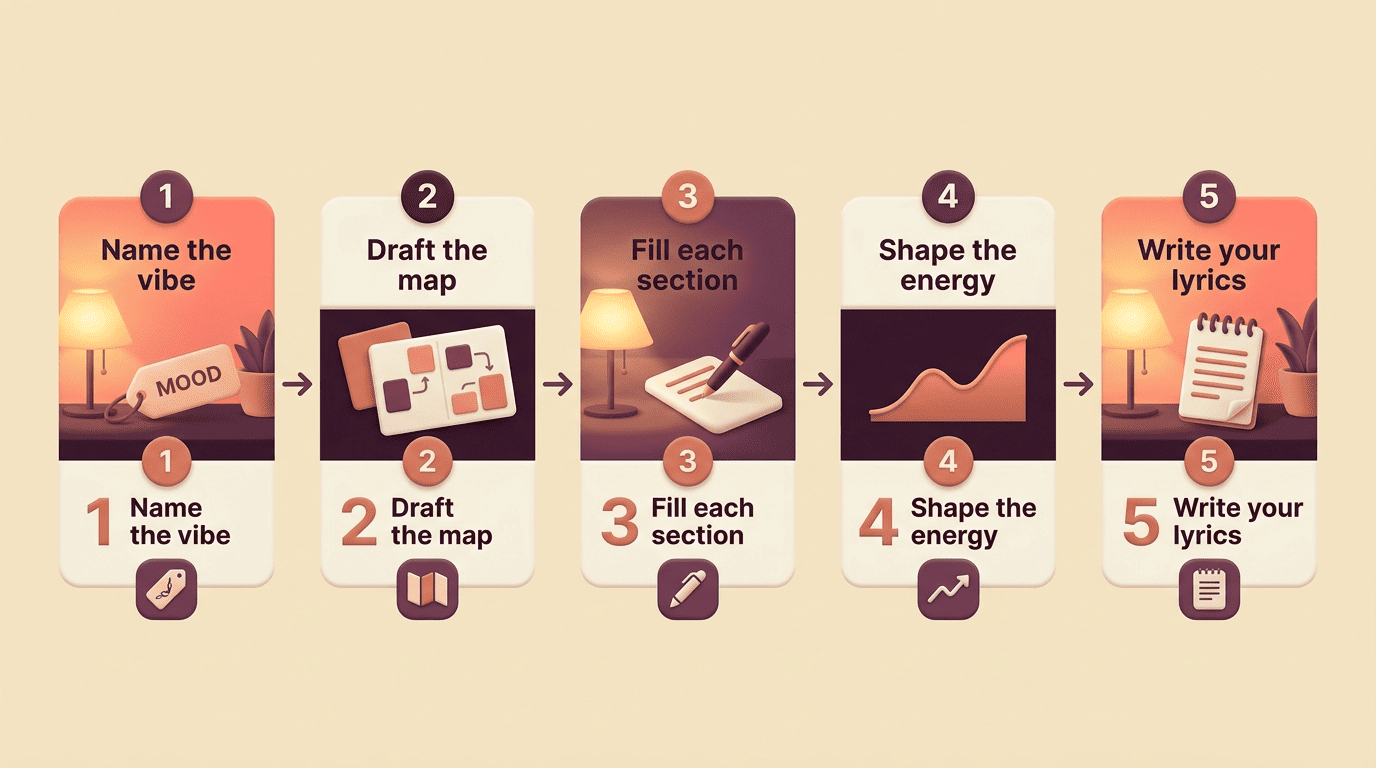
Turning a loose idea into a mapped-out song usually follows the same handful of steps, whether you’re doing it by hand or letting a tool speed things up:
- Name the vibe: genre, mood, theme, and a rough tempo.
- Let the tool draft a section map (e.g., ABABCB) as a starting blueprint.
- Fill each section by its job — the verse tells the story, the chorus delivers the hook.
- Shape the energy curve; add or drop a pre-chorus or bridge to control the lift.
- Write original lyrics into the map — the structure is a frame, the words are yours.
- Revise: swap the form (try AABA instead of verse-chorus), tighten the outro, and test the hook out loud.
The lyrivo ai song writer can handle steps one and two in seconds, then help you write the actual lines once the map is set. One important note: use a generator like this to help you write ORIGINAL lyrics inspired by your own idea — it’s built to map a blueprint and spark your imagination, not to copy the words of an existing song.