AI Pop Song Lyrics Generator: Write Catchy Hooks and Radio-Ready Choruses
Every hit starts with one line you can’t stop humming. An ai pop song lyrics generator is a creative co-writer that helps you shape that line into full verses, a soaring chorus, and a hook that sticks — while you stay the artist. Pop’s entire architecture, from the verse to the song structure that carries it, is built to make that one line unforgettable. If you want a dedicated ai song writer to shape that line with you, that’s exactly the gap these tools fill.
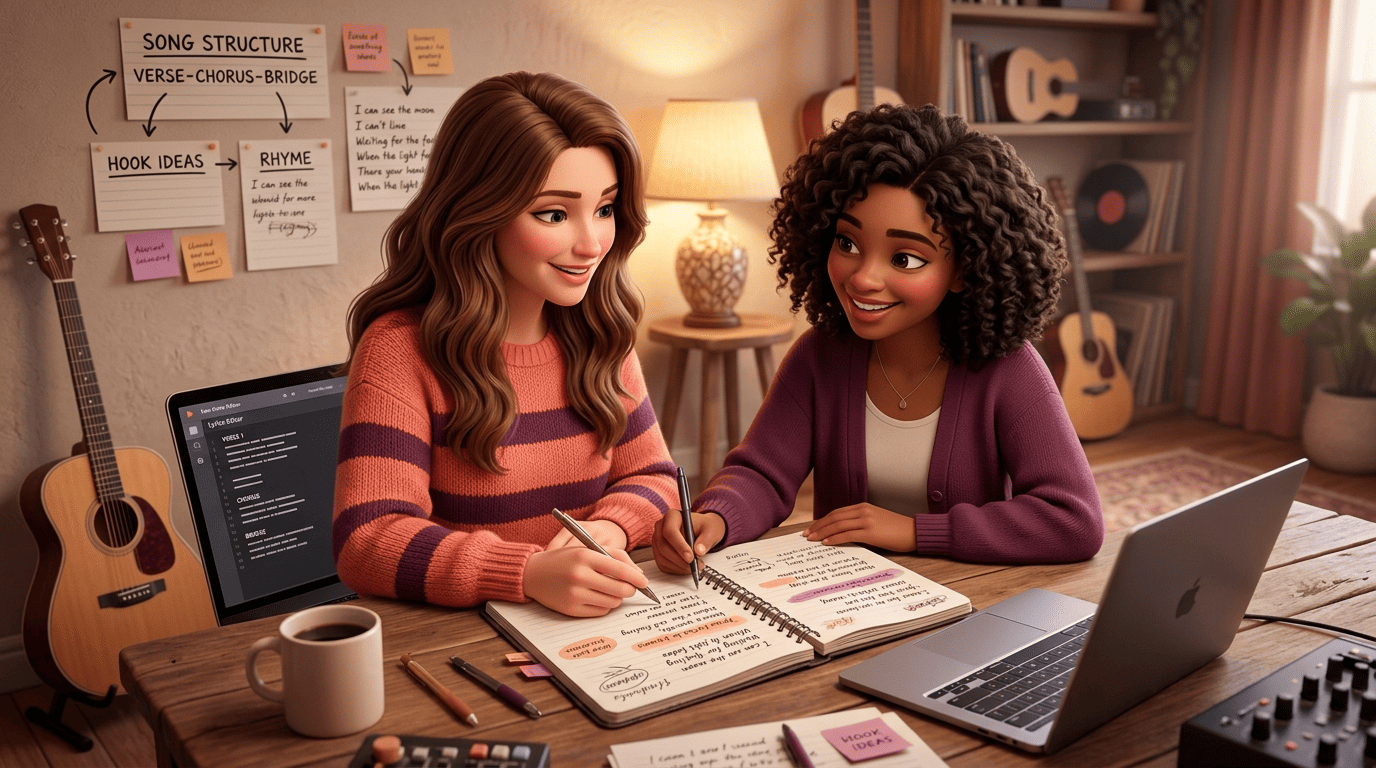
Pop rewards clarity and catchiness over complexity. This guide breaks down how the tool works, the anatomy of a great hook, contemporary song structure, and how to keep your lyrics original.
What an AI Pop Song Lyrics Generator Actually Does
A pop song lyrics generator takes a single word, theme, or emotion and grows it into structured sections — labeled verses, a pre-chorus, and a chorus — instead of handing you one undifferentiated block of text. Most tools in this space work as an AI songwriting assistant rather than a replacement: you feed it a spark, it hands back a scaffold, and you shape the final voice. The typical flow is three steps — pick a topic, generate a draft, refine the lines you don’t love — and most tools do this for free without an account.
Used well, a digital co-writer solves a very specific problem: staring at a blank page with a melody in your head and no words to match it.
What the tool typically does for you:
- Turns one topic, mood, or phrase into a full draft with labeled sections
- Suggests rhyme options and alternate phrasing on demand
- Matches syllable count and rhythm to a rough melody or tempo
- Offers several chorus variations so you can compare and combine
- Lets you regenerate a single verse without losing the rest of the draft
From a single idea to a full draft
You enter a theme, a mood, and — if you already have one — a candidate hook line. The assistant returns a structured draft: verses, a chorus, sometimes a bridge, each one clearly marked (Verse), (Pre-Chorus), (Chorus), (Outro). That labeling matters more than it sounds; it turns one shapeless concept into sections you can edit independently. For a lot of songwriters, this is what actually cures writer’s block — not better ideas, but a structure to react to instead of an empty page.
You stay in the driver’s seat
The AI is a co-writer, not a replacement. The best lyrics tend to come out of iteration: generate three or four versions of the same chorus, pull the strongest line from each, then rewrite the whole thing in your own voice. Treat the first draft as raw material, not a finished song.
Anatomy of a Catchy Pop Hook
Why the hook carries the song
Pop lives and dies by its hook. A hook is the phrase a listener remembers after a single play — the line that gets stuck, sung back, and quoted out of context. That’s not a coincidence; it’s the mechanism behind an earworm, the involuntary musical repetition that keeps a fragment looping in someone’s head hours after the song ends. A hook only works if the words underneath the melody are simple enough to sing back immediately — which is precisely why the chorus thrives with repetition and simplicity rather than dense, complicated phrasing.
Hook-writing techniques the AI can apply
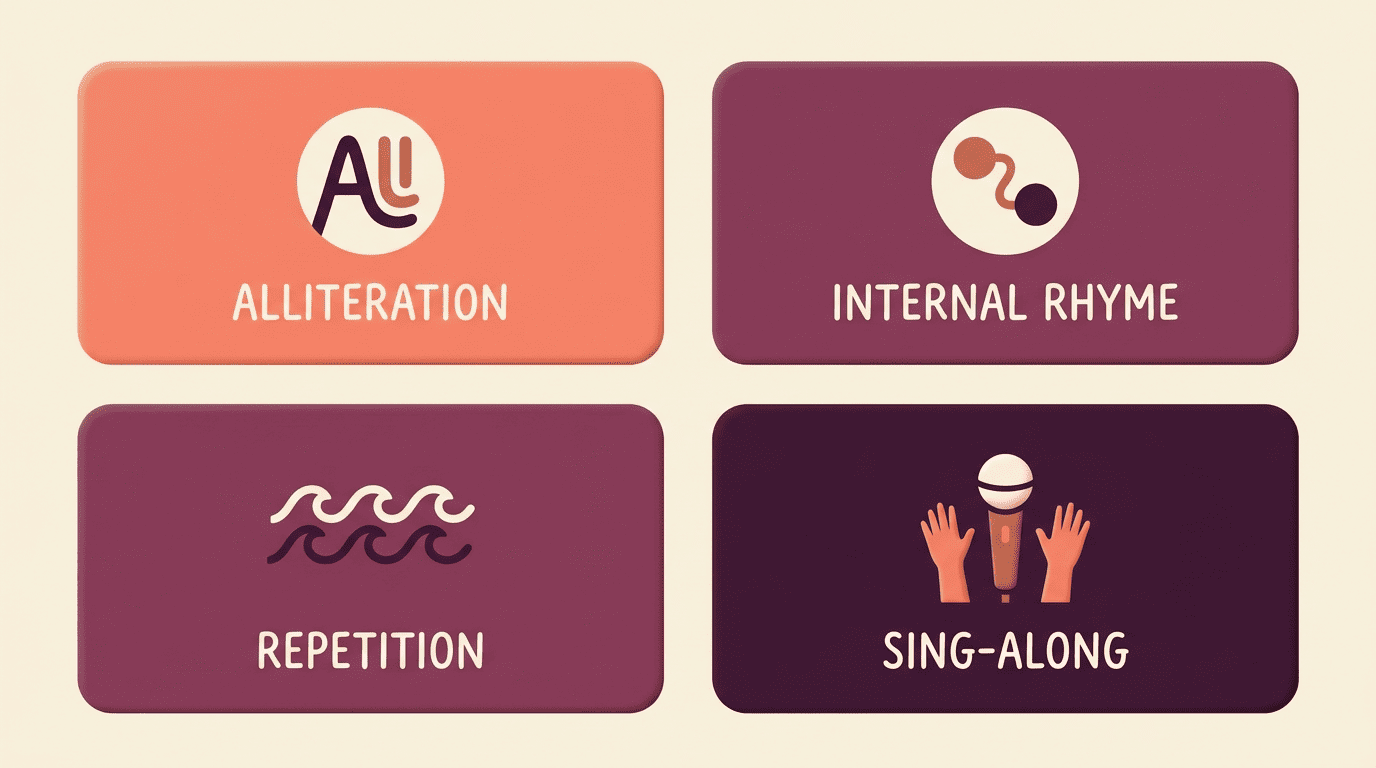
A generator leans on a handful of proven devices when it drafts a hook line:
- Alliteration — repeating a starting sound for rhythm, as in «Dance Under the Stars»
- Internal rhyme — rhyming words inside the same line, like «Fire meets Desire»
- Rhythmic repetition — repeating a short phrase on the beat so it locks into memory
- A «repeat-after-me» line — a call-and-response phrase built to be sung along to live
Whichever technique you use, keep one clear idea in one line. A hook trying to say two things at once rarely sticks to either.
Contemporary Pop Song Structure
Modern pop mostly follows a blueprint you can predict before you press play: Verse, Pre-Chorus, Chorus, Verse, Chorus, Bridge, Chorus, Outro. Each section has a job, and a generator works best when you tell it which job you’re asking for.
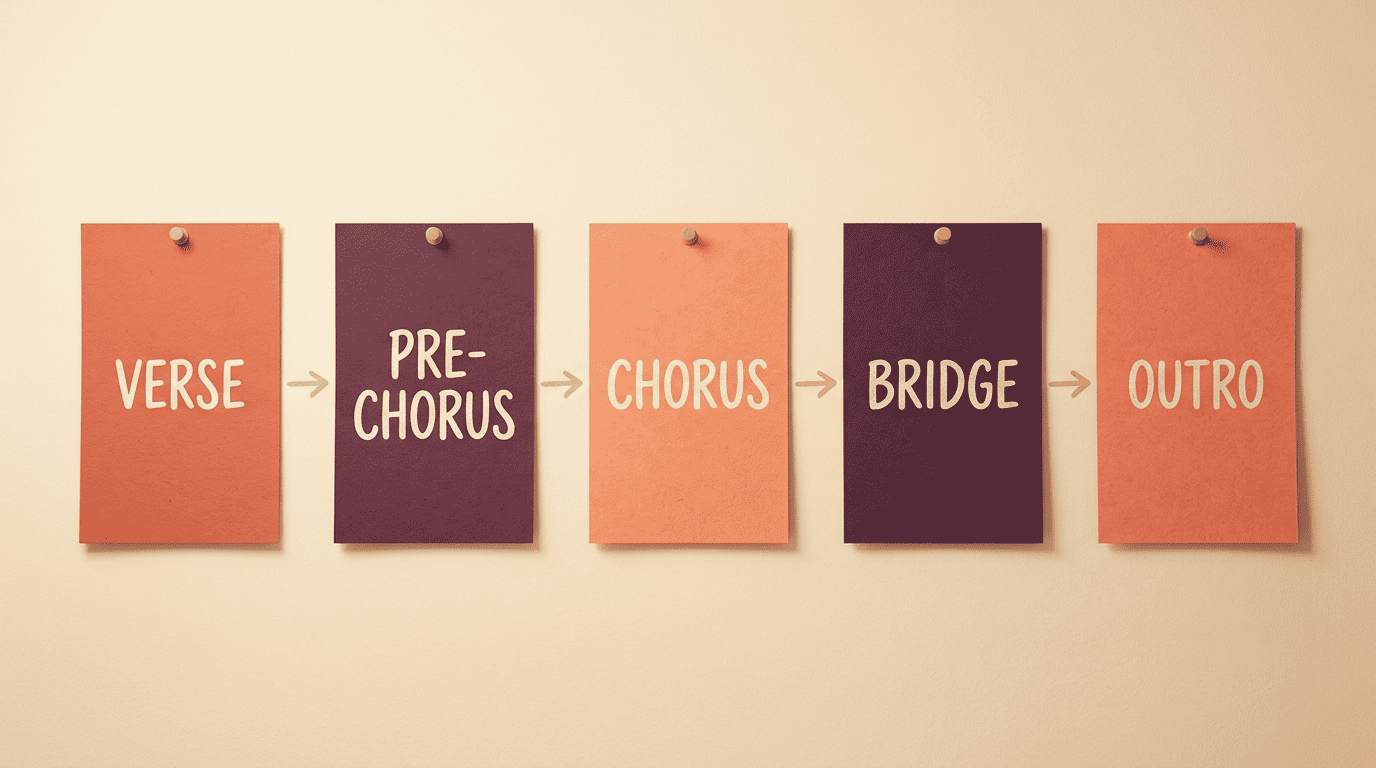
The verse–pre-chorus–chorus–bridge map
| Section | Role | What to ask the AI for |
|---|---|---|
| Verse | Tells the story, sets the scene, adds detail | Concrete imagery, a specific moment, a POV |
| Pre-Chorus | Builds tension, raises energy into the drop | Rising phrasing, shorter lines, urgency |
| Chorus | The payoff — carries the hook, repeats each time | The clearest, most singable line in the song |
| Bridge | Contrast after the second chorus, breaks the pattern | A shift in perspective, tempo, or emotion |
| Outro | Lands the song, echoes the hook one last time | A fade on the hook or a final image |
If you want a dedicated ai songwriting assistant to map a draft against this exact structure, that’s the fastest way to see which section is missing.
Tension and release
A well-charted pop song builds tension across the verse and releases it in the chorus — that’s the «drop» listeners feel even without naming it. The bridge exists to prevent monotony: after two full choruses, a contrasting section resets the ear before the final chorus lands harder. Wikipedia’s overview of song structure documents how consistently this pattern shows up across commercial pop, not just as a trend but as a near-default form.
Repetition, Simplicity, and the Science of Earworms
What 40 years of hits reveal
A 2024 study published in Scientific Reports analyzed roughly 12,000 English-language songs across five genres (pop, rock, rap, country, and R&B) from 1980 to 2020 and found a clear trend: lyrics have become simpler and more repetitive over time, with a rising share of choruses per song. Simplicity isn’t a shortcut — it’s a design choice aimed squarely at memorability.
Pop music lyrics have become simpler and easier to comprehend over time: not only does the lexical complexity of lyrics decrease… but we also observe that the structural complexity… has decreased.
Scientific Reports, 2024
Making a line stick without getting boring
A generator (and a human co-writer) can lean on a few reliable moves to make a line repeat-worthy without wearing it out:
- Repeat the key phrase at the same spot in every chorus
- Vary a single word each pass so the repetition doesn’t go flat
- Contrast the verse’s detail against the chorus’s simplicity
- Keep lines short and singable rather than dense with syllables
The balance is between repetition and freshness — repeat the hook, but let something small shift around it each time.
Rhyme Schemes and Mood
Choosing a scheme
The rhyme scheme you pick shapes how a section feels before a listener even parses the words.
| Rhyme scheme | Feel | Best used for |
|---|---|---|
| ABAB | Flowing, conversational | Ballads, verses that tell a story |
| AABB | Punchy, driving | High-energy choruses, hooks |
| AAAA | Insistent, chant-like | Bridges, hype sections |
| Slant / near rhyme | Subtle, modern | Verses that need to sound less «written» |
| Internal rhyme | Dense, rhythmic | Rap-adjacent pop, fast verses |
Matching words to emotion
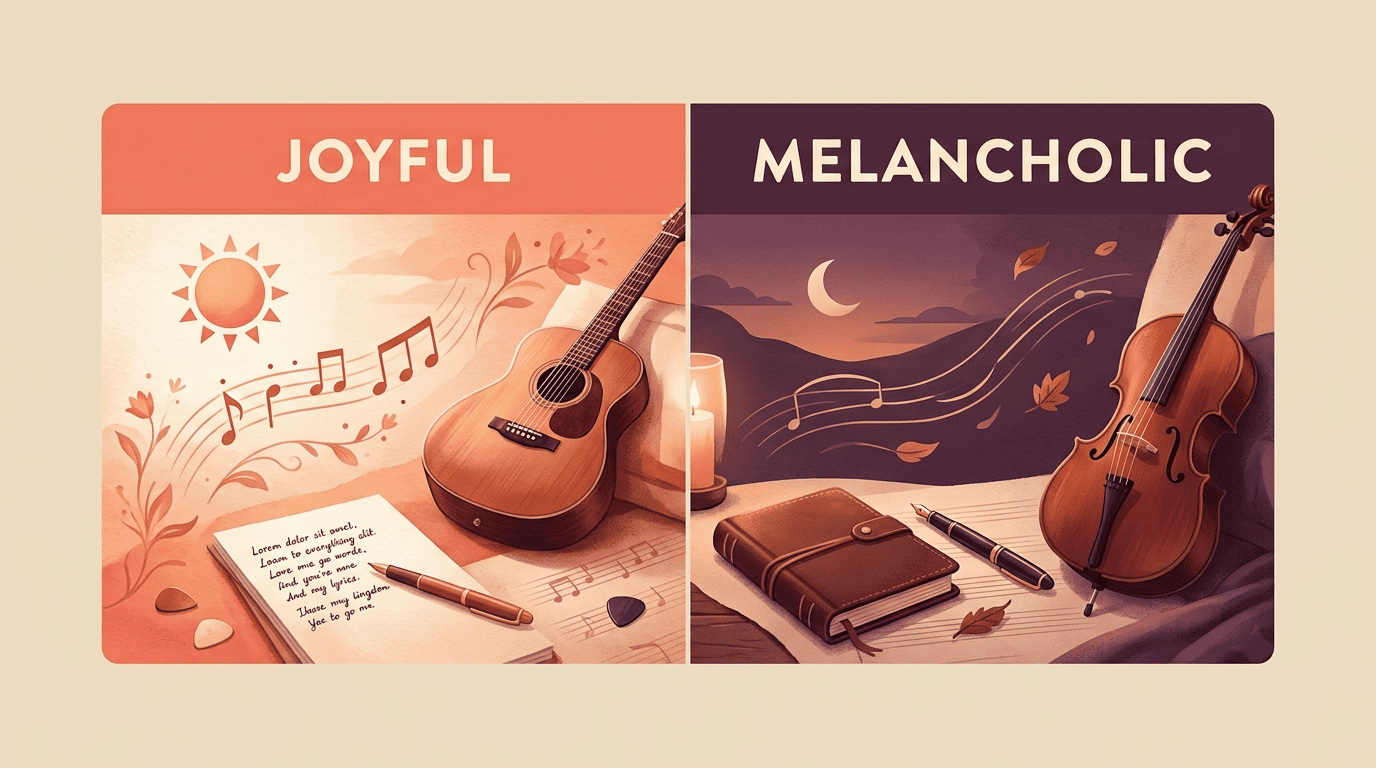
Rhyme shapes energy just as much as it shapes sound. A joyful chorus tends to pair bright imagery with a fast rhythm — short vowels, quick consonants, upbeat verbs. A melancholic one leans on longer vowel sounds and reflective, slower-moving metaphors. A good AI lyricist adjusts word choice to match the mood you specify, not just the rhyme pattern.
How to Prompt the Generator for Better Lyrics
The specificity rule
«Write a love song» is too vague to produce anything memorable — the tool has nothing specific to hold onto. A better prompt gives it a concrete emotion, a specific moment or scene, a genre, and an image to build around. Keep it to one core concept per sentence, so the generated lyrics don’t drift across three different ideas at once.
A prompt checklist
Before you generate, run through this:
- Topic — what is the song actually about, in one sentence?
- Main hook — do you already have a line, or should the AI propose one?
- Mood — joyful, heartbroken, defiant, nostalgic?
- Genre or reference — pop, pop-rock, dance-pop, a specific era?
- POV — first person, second person, a story about someone else?
- What to repeat in the chorus — the exact phrase you want the listener to remember
Working through a checklist like this with a lyrivo ai draft in front of you turns a vague brief into something the generator can actually act on, instead of guessing at what you meant.
Keeping Your Pop Lyrics Original
Make it truly yours
AI-generated output is almost always unique in its exact wording, but it’s still worth running a plagiarism check before you release anything — especially a hook, since short catchy phrases are the most likely to accidentally overlap with an existing song. Write original lines rather than lifting a phrase you remember from somewhere else, even unintentionally. In the United States, authorship and copyright protection for purely AI-generated content are limited; the U.S. Copyright Office has made clear that human creative contribution is what anchors a copyright claim. Your edits, your phrasing choices, and your voice are what actually make the song yours.