
AI Country Song Lyrics Generator: Write Real, Original Country Songs
An AI country song lyrics generator turns a topic and a feeling into a finished set of verses, a chorus, and a bridge — the story part of the song, not the audio. According to the Nashville Songwriters Association International, craft fundamentals like structure and imagery are what separate a forgettable draft from a song people remember, and that’s exactly the gap a good tool should help close. Our ai song writer does exactly this for the country genre.
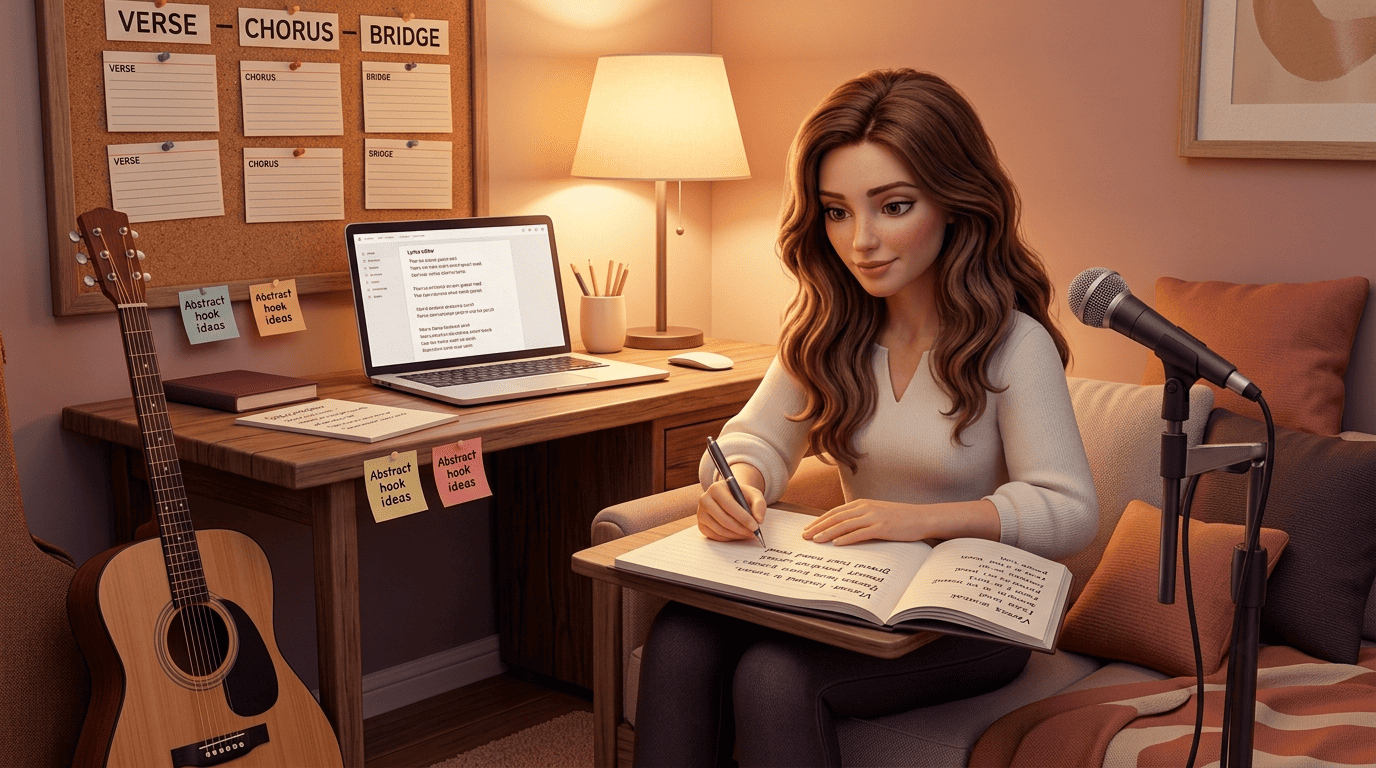
You bring the truth — a gravel road, a name, a heartbreak — and the generator shapes it into singable country lines you can edit, keeping the storytelling that defines the genre. Nothing here writes a melody or a track; it hands you words built for a country song, ready to sing, rework, or hand to a vocalist.
What an AI Country Song Lyrics Generator Actually Does
A country lyrics generator works from a short brief, not a blank page. You give it up to three topics and up to three emotions, and it returns a structured lyric with clear section tags — [Verse], [Chorus], [Bridge] — instead of one long block of text. That’s a meaningful difference from tools built for country song generation as audio: this is lyrics-first, an AI co-writer for the words, not a track-maker.
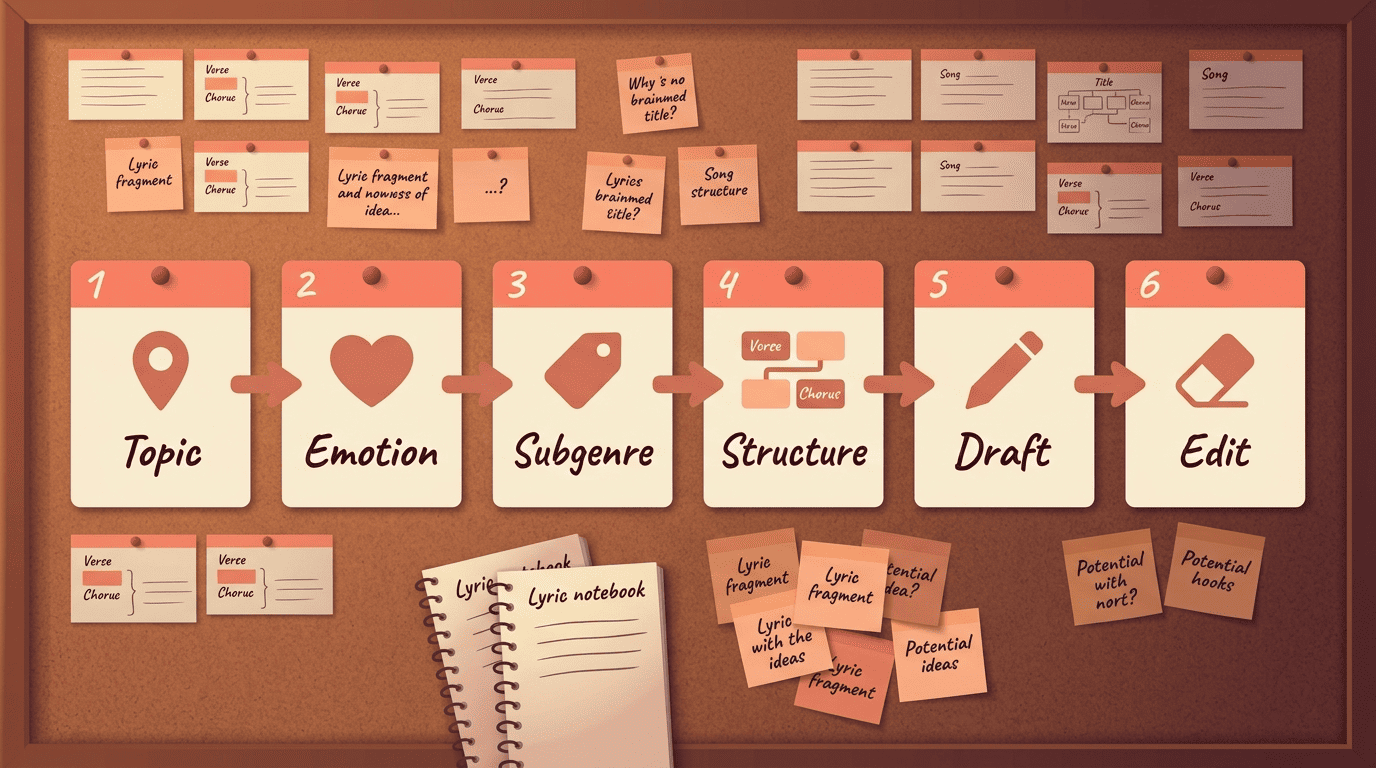
The default shape it reaches for is verse–chorus–verse–chorus–bridge–chorus, the same skeleton that holds up most radio country songs. You can work in a couple of ways depending on how much direction you want to give:
| Input you provide | What the country song maker returns |
|---|---|
| Topic + emotion (Prompt mode) | Full lyric drafted from scratch around your brief |
| Your own lines (Lyrics mode) | Continuation, polish, or rhyme-matched completion |
| Subgenre selection | Vocabulary and imagery shifted to match the style |
| Structure preference | Verse/chorus/bridge arrangement adjusted |
From a Line to a Full Song
Getting from one idea to a finished draft usually follows the same path:
- Pick a topic. A place, a person, a memory — something concrete, not abstract.
- Name the emotion. Grief, pride, longing, defiance — pick one or two, not five.
- Choose a subgenre. Honky-tonk, bluegrass, outlaw, or country pop, each pulling different words.
- Set the structure. Keep the default verse-chorus-verse-chorus-bridge-chorus or request something leaner.
- Generate the draft. The AI country lyrics generator returns tagged sections you can read as a whole song.
- Edit for truth. Swap in your own details — the real road, the real name — so the story is yours.
Lyrics First, Not Audio
Many tools that call themselves «country song generators» are really making a finished audio track — a beat, a melody, a mixed vocal. That’s a different job. Here, the focus stays on the words: the sentence-level craft of a country song, the rhyme and the story. What you get is a lyric sheet you can sing over a guitar, hand to a session vocalist, or set to a melody of your own. That narrower focus is deliberate — it’s the part of songwriting that’s hardest to fake and easiest to make your own.
Three Chords and the Truth: The Heart of a Country Song
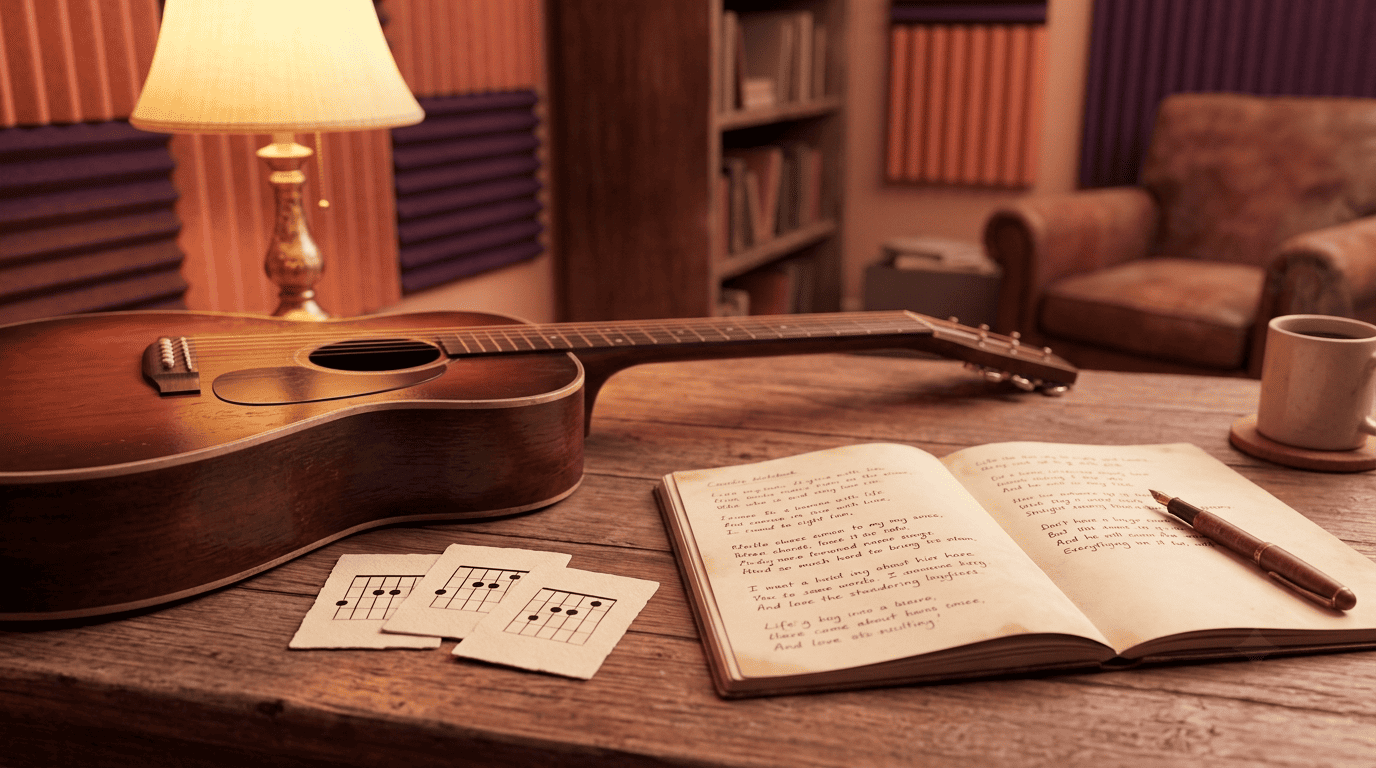
Nashville songwriter Harlan Howard famously summed up the genre in one line: country music «ain’t nothin’ but three chords and the truth.» The phrase has become shorthand for the whole tradition, well documented on Wikipedia’s entry for Three Chords and the Truth, and it points at something real about how the music works.
Musically, that’s often literal — a I–IV–V chord progression, three chords that most guitarists learn in their first year. Because the music stays simple, almost all of the weight in a country song falls on the words. A plain progression can’t save a vague lyric, and it doesn’t need to save a specific, honest one. That’s why an AI country song lyrics generator built for this genre has to prioritize the story over clever wordplay — the chords were never going to carry the song.
Country music ain’t nothin’ but three chords and the truth.
Harlan Howard
Why «The Truth» Beats Clever
A few principles separate a country lyric that lands from one that just rhymes:
- Specific over vague. «The porch swing where you told me» beats «a place we used to be.»
- Plain words. Country audiences trust simple language over ornate metaphor.
- Real emotion. One true feeling, followed all the way through, outlasts three half-explored ones.
- An image you can see. If a listener can’t picture it, the line isn’t doing its job yet.
The Building Blocks: Country Song Structure
Most country songs are built from a small set of recurring parts, each with its own job and its own rough length. Verse tags and chorus tags — [Verse], [Chorus] — are exactly how a country lyrics generator marks these sections in a returned draft, which makes the shape easy to scan and edit.
| Section | Role in the song | Typical length |
|---|---|---|
| Verse | Advances the story, adds detail | 4-8 lines |
| Pre-chorus | Builds tension into the hook | 2-4 lines |
| Chorus | Delivers the hook, repeats with variation | 4-6 lines |
| Bridge | Shifts perspective or raises the stakes | 2-4 lines |
The Hook Is the Whole Song
The hook — usually the title line, planted in the chorus — is the part of a country song people remember after one listen. Harlan Howard was known for titles that work like a question: a line that makes the listener ask «why,» and then the rest of the song answers it. A weak hook can bury a strong verse; a strong hook can carry a simple one. When you’re shaping a draft from an AI co-writer, the title and the chorus line are worth more editing time than anything else in the song.
Rhyme, Meter, and the Singable Line
Rhyme in country songs tends to follow a few reliable patterns:
- AABB — paired end rhymes, common in verses for a driving, forward feel.
- ABAB — alternating rhymes, giving verses more room to breathe.
- Internal rhyme — a rhyme placed mid-line, adding texture without forcing the end word.
- Near-rhyme — words that echo without matching exactly (road/home), which keeps language natural instead of forced.
Meter matters just as much as rhyme scheme: a singable line usually holds a consistent syllable count so it fits the phrasing of a melody without the singer having to rush or stretch a word to make it fit.
Storytelling and Imagery That Feels Country
At its core, a country song is a short story — a central character, a specific place, and usually a turn partway through where something changes. The imagery that sells that story is almost always sensory and concrete: a porch swing, a gravel road, a mason jar, a dusty road at dusk. Those details do more work than any abstract statement of feeling ever could.
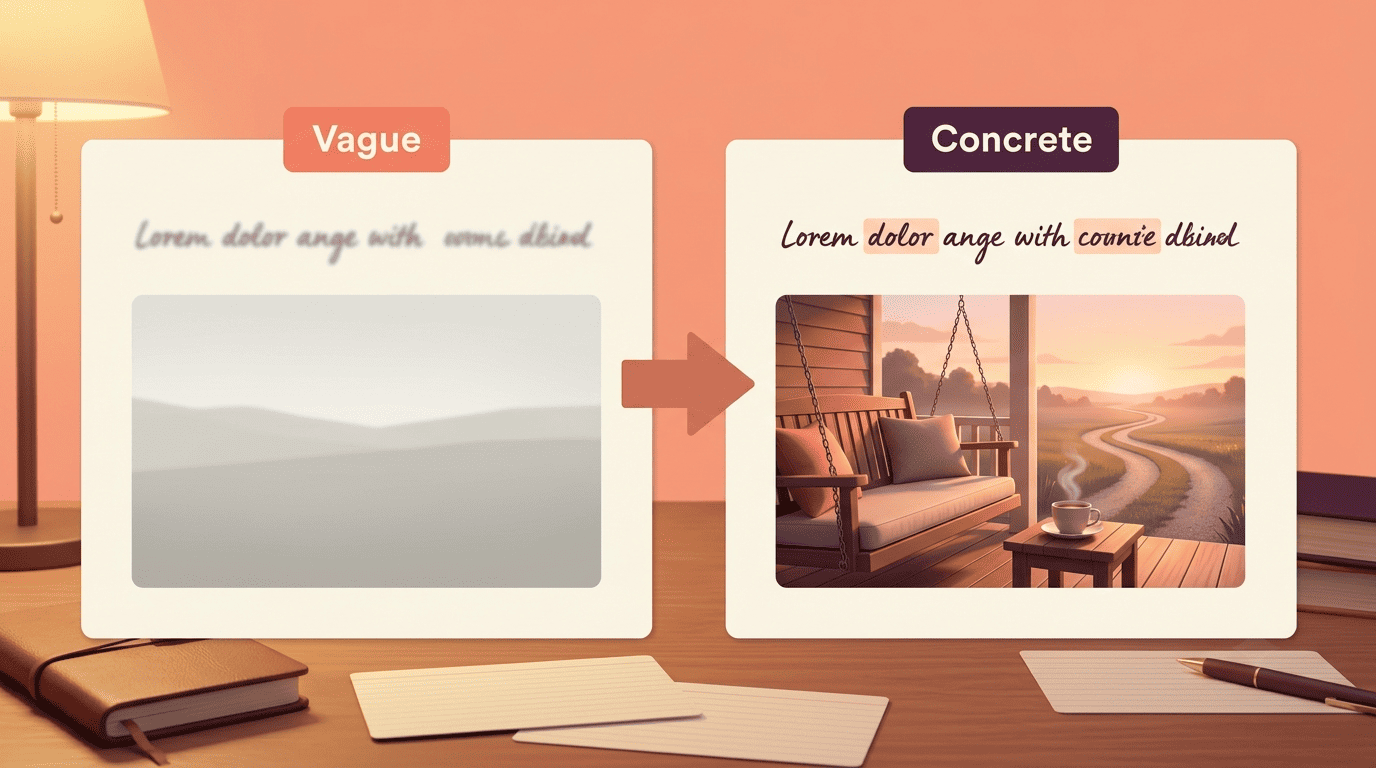
The fastest way to strengthen a draft is to trade a vague feeling for a picture a listener can actually see. The same idea, rewritten concrete, lands harder every time.
| Vague line | Concrete country rewrite |
|---|---|
| «I miss the way things used to be» | «I still smell your coffee on the porch at six» |
| «We had some good times together» | «We split a beer on the tailgate till the fireflies came out» |
| «Life is hard sometimes» | «The truck won’t start and the rent’s already late» |
| «I’m thinking about you tonight» | «Your number’s still the first one my thumb finds in the dark» |
Show the Story, Don’t Summarize It
A few habits keep a country lyric showing instead of telling:
- Name a place. A real or real-feeling location grounds the whole song.
- Name an object. A truck, a ring, a photograph — a physical thing the listener can picture.
- Use one turn or twist. Let something change between the first verse and the last.
- End on an image, not a summary. Close the song on a picture, not a stated moral.
Country Subgenres and How the Lyrics Shift
Country isn’t one sound or one vocabulary — the subgenre changes both the mood and the words worth reaching for.
| Subgenre | Mood | Typical vocabulary and imagery |
|---|---|---|
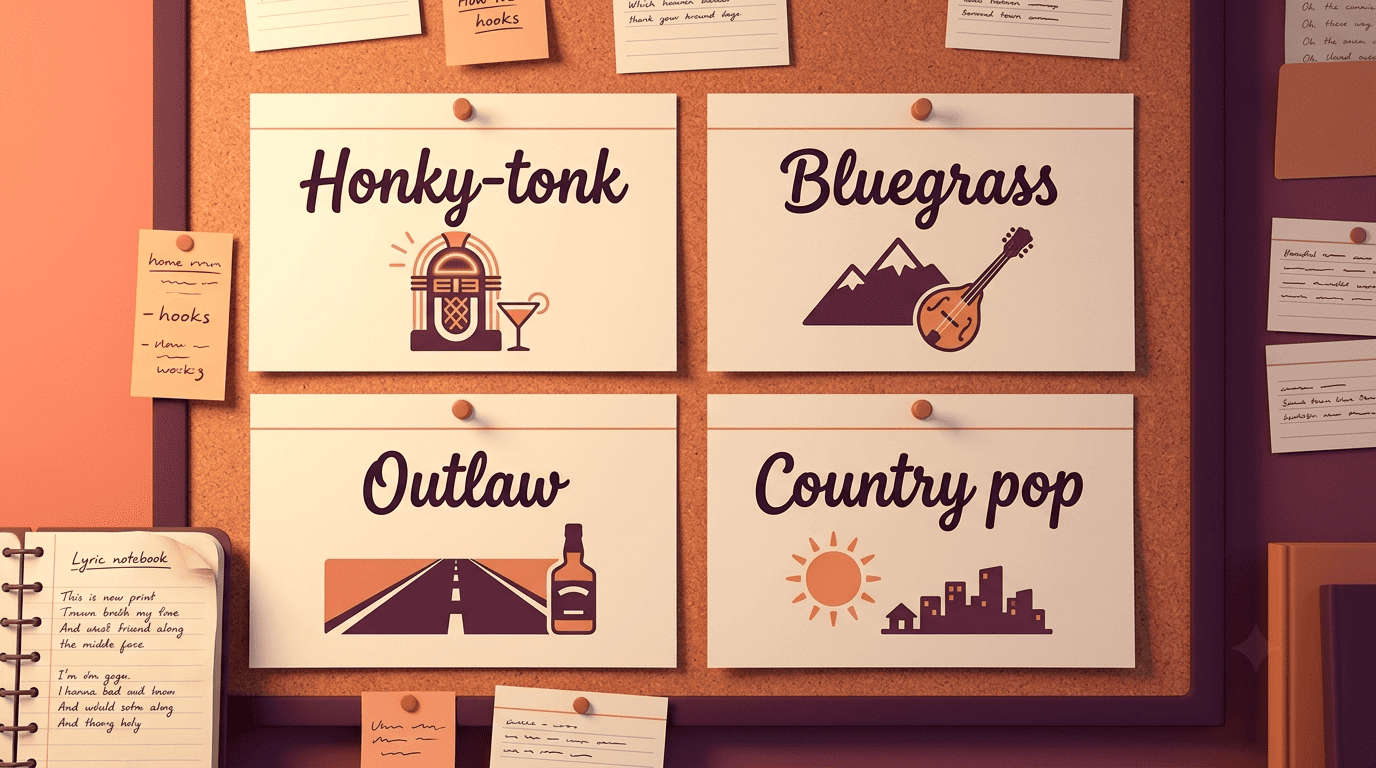
| Honky-tonk | Barroom, dance-floor, heartbreak-with-a-drink | Jukebox, neon, last call, two-step |
| Bluegrass | High lonesome, mournful, acoustic | Mountain, mandolin, homeplace, the high lonesome sound |
| Outlaw | Rebellion, defiance, on-the-road | Highway, whiskey, freedom, the law |
| Country pop | Polished, radio-hook-driven, upbeat | Summer, hometown, small-town nights |
| Texas country | Rooted, regional, storyteller-driven | Ranch, border towns, dance halls |
Artists across these lanes show how differently the same genre can sound: Johnny Cash’s outlaw grit, Dolly Parton’s storytelling warmth, Willie Nelson’s road-worn phrasing, and Chris Stapleton’s bluegrass-inflected soul all pull from country’s shared roots while landing in very different places.
Picking a lane before you write gives the generator a clear target, so the vocabulary and imagery arrive already tuned to the mood you want.
Matching the Words to the Style
Writing honky-tonk calls for barroom specifics — a jukebox, a two-step, a last call — while bluegrass leans on mountain imagery and that high lonesome sound described by traditional pickers and singers. Outlaw country reaches for the open road and a defiant streak; country pop keeps the imagery warmer and more universal, built for a wide radio audience rather than a single region.
Getting the Best Country Lyrics from the Generator
A few habits make a real difference in what an AI country lyrics generator hands back:
- Give a true detail. A real place or object beats a generic prompt every time.
- Name the feeling precisely. «Quiet grief» pulls different words than «angry grief.»
- Pick a subgenre. Even a rough choice narrows the vocabulary toward something usable.
- Set the structure. Decide up front if you want the full verse-chorus-bridge shape or something shorter.
- Edit for one image. Pick the single strongest picture in the draft and build the rest of your edits around keeping it sharp.
Organizations like the Country Music Association and the Nashville Songwriters Association International track the craft and business side of the genre — useful reference points if you want a sense of where the tradition has been and where it’s heading.
Keep It Yours: Original Lyrics and Credit
Use the generator the way you’d use any co-writer — as a starting point for your own original song, not a way to copy someone else’s. Good practice is to run a finished draft through a plagiarism check before you call it done, the same habit most working songwriters already have. On the copyright side, the U.S. Copyright Office has published guidance on AI-authored works, generally noting that purely machine-generated text has limited copyright protection, while meaningful human authorship and editing still qualify for it. Keep your fingerprints on the final lyric — the true detail only you would know — and it stays genuinely yours.