
AI Love Song Generator: How to Turn Your Feelings Into Lyrics That Feel Real
Writing a love song for someone you adore can feel impossible — the feeling is huge, and the blank page is bigger. An ai love song generator turns that overwhelm into a working first draft in minutes: you feed it your story, and it hands back verses, rhymes, and a hook you can shape. Think of Lyrivo, an AI songwriting assistant, as a co-writer for the words — it drafts and edits lyrics, not audio, so the finished song still sounds like you.
This guide covers what makes a love song land, how to structure one, and how to use AI to draft romantic lyrics without losing the personal detail that makes them yours.
What Makes a Love Song Actually Work
The love song has been the single most common theme in popular music for decades. According to songwriting researcher Glenn Fosbraey, a 2017 study he cites found love was the most frequent lyrical subject in every decade since the 1960s — which is why standing out is the real challenge for anyone writing love song lyrics today.
Specificity beats sentiment
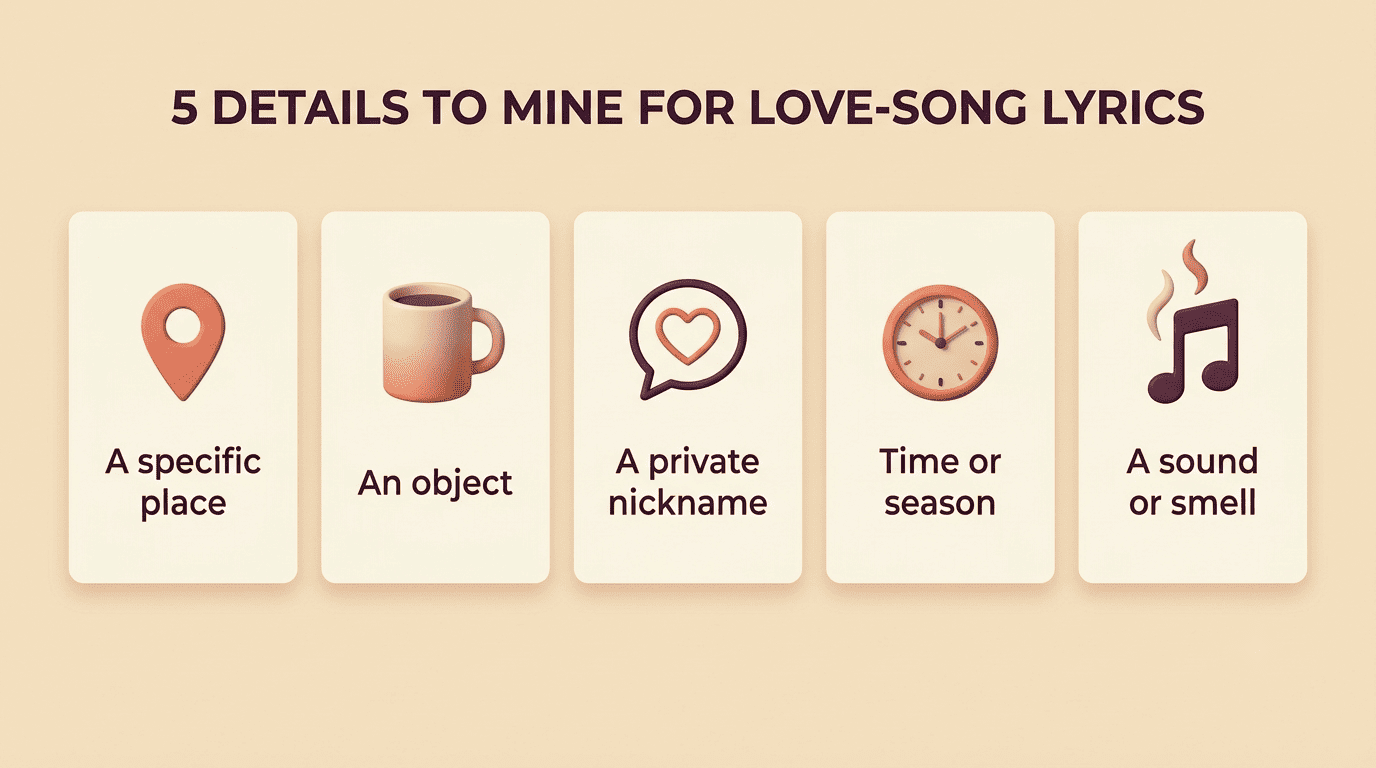
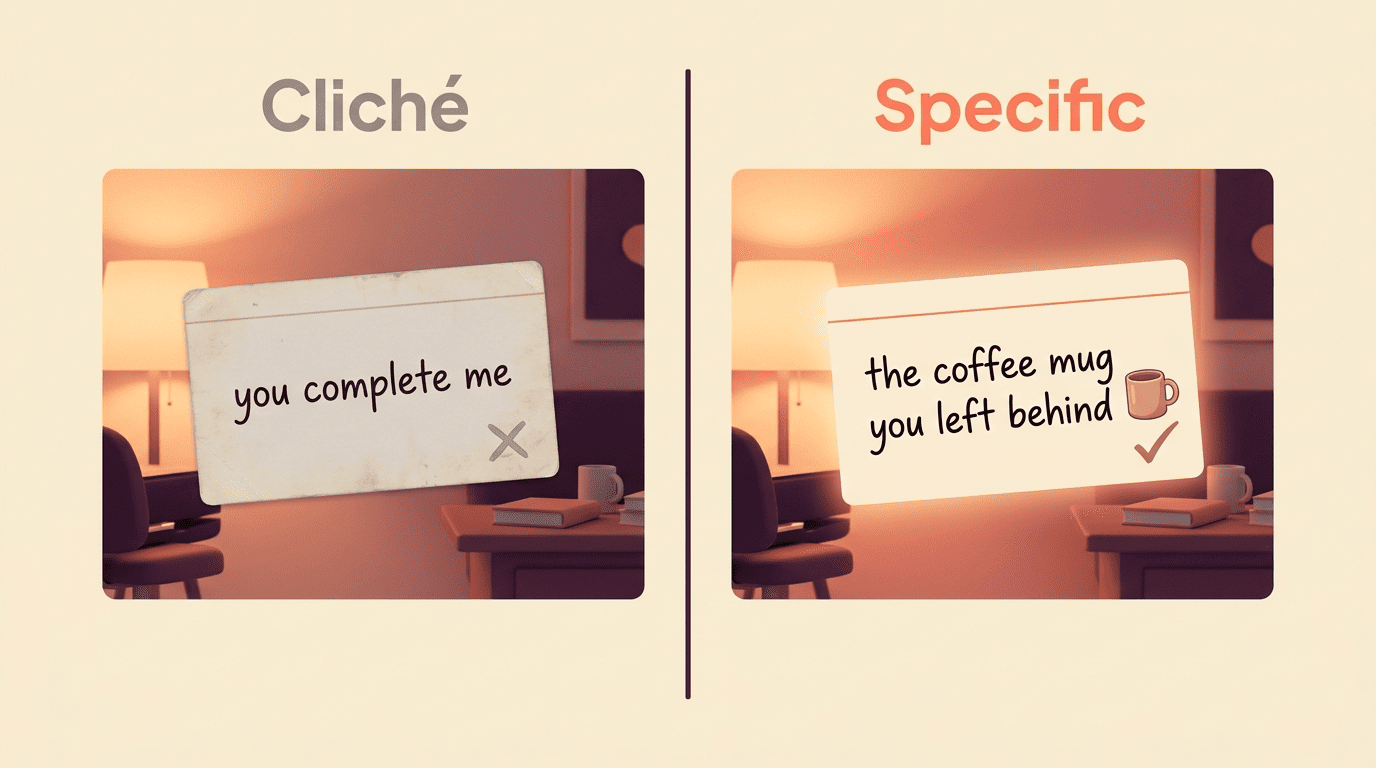
The great paradox of love songs: the more specific you get, the more universal they feel. «Love is specific,» as one songwriting studio puts it — «it’s universal because it happens to everyone.» A line like «the smell of coffee from the mug you left behind» hits harder than «I miss you in the morning,» because it grounds a shared feeling in one real moment. Before you write a single line, mine your own memory for the small, unglamorous details that only the two of you would recognize:
- A specific place — the diner booth, the airport gate, the porch step
- An object — a jacket, a mug, a playlist, a handwritten note
- A private nickname or inside joke
- The exact time of day or season something happened
- A sound or smell tied to the memory (rain on a windshield, coffee, a particular song)
Warmth over cleverness
Berklee songwriting chair Bonnie Hayes — who wrote «Love Letter» for Bonnie Raitt, a track from Raitt’s Grammy-winning Nick of Time album — reminds writers that honesty outperforms cleverness in a romantic song. You are not trying to win; you are trying to be understood. A slightly imperfect line that’s true will always beat a polished line that sounds borrowed from someone else’s love ballad.
The Six Kinds of Love Song (Pick Your Angle First)
Before you write a word, decide what kind of love song this is. Songwriting guides often sort love songs into six emotional angles, or group the same territory into three broader forms — the Compliment, the Plea, and the Celebration. Either lens works; the point is to commit to one angle before you start.
| Type | What It Expresses | Example Mood |
|---|---|---|
| Admiration | Praising who someone is | «You’re the calm in every storm» |
| Request / Plea | Asking for love, closeness, or a second chance | «Come back, stay, don’t let this end» |
| Comfort / Reassurance | Steadying someone through a hard moment | «I’ve got you, we’ll figure it out» |
| Celebration | Marking a milestone or joyful commitment | Wedding songs, anniversary songs |
| Longing | Missing someone who’s far away or gone | Distance, memory, unfinished stories |
| Heartbreak | Processing loss or a fading relationship | Grief, regret, moving on |
Picking one angle early keeps the whole song focused — a chorus that tries to be a plea and a celebration at once usually ends up saying nothing clearly.
Structure: The Shape a Love Song Wants
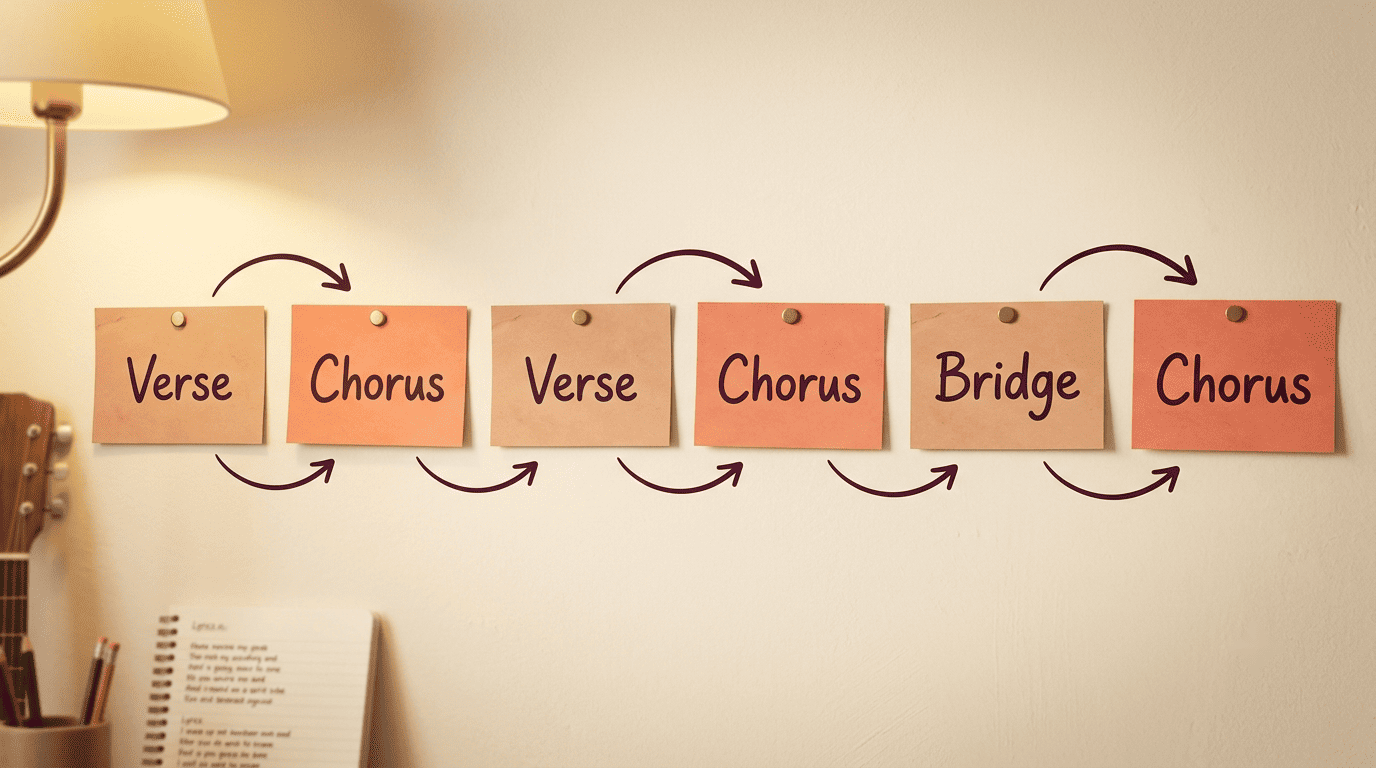
Most love songs follow a familiar map — Verse, Chorus, Verse, Chorus, Bridge, Chorus — and that familiarity is a feature, not a flaw: research on musical expectation generally finds listeners favor a degree of predictability, since a structure they can anticipate lets them settle into the feeling instead of the form. Working within that shape, not against it, is what makes a verse-chorus form feel satisfying rather than formulaic.
What each section does
| Section | Job | Tip |
|---|---|---|
| Verse | Tells the story, adds specific detail | Load it with names, places, and moments — save the feeling word for the chorus |
| Pre-chorus | Lifts the energy into the hook | Keep it short; two or four lines that build tension |
| Chorus / Hook | States the central feeling in one repeatable line | Plain language beats a clever line no one can hum back |
| Bridge | Adds a turn, a new angle, or a deeper admission | Use it once, near the end, to say the thing you haven’t said yet |
The chorus carries the promise
The chorus, your hook, is where the central feeling lives — the line someone hums after one listen. Keep it plain, repeatable, and emotionally true. Before you lock it in, run it through a quick check:
- Can you say it out loud in one breath?
- Does it name the actual feeling, not a vague stand-in for it?
- Would it still make sense read as a text message, not just sung?
- Does every verse point back toward this one line?
Imagery, Rhyme, and the Emotional Arc
Paint with the five senses. Engage sight, sound, smell, touch, and taste. Fresh nature imagery — seasons, tides, a blooming garden — beats worn phrases like «burning flame.» A metaphor works best when it’s borrowed from your actual life together, not from a rhyming dictionary.
Avoid the phrases everyone already used. Clichés like «you complete me» or «burning like fire» read as generic because thousands of romantic songs got there first. Swap the abstract stand-in for the concrete image it’s trying to describe, and the line becomes yours again.
Let the rhyme serve the meaning, not the other way around. If a rhyme forces you into a word that doesn’t belong, cut it and rewrite the line — a slightly imperfect near-rhyme almost always beats a perfect rhyme that says the wrong thing.
Rhyme without forcing it
| Scheme | Pattern | Feel |
|---|---|---|
| AABB | Couplets, line 1 rhymes with 2, 3 with 4 | Simple, sing-song, easy to follow |
| ABAB | Alternating lines rhyme | Conversational, keeps momentum |
| ABCB | Only lines 2 and 4 rhyme | Loose, natural, less «written» |
Build an emotional arc
A love song should move — from longing to reassurance, from doubt to devotion. Direct address («I,» «you») in the present tense, a technique Berklee’s Pat Pattison highlights, pulls the listener into the room with you instead of describing the relationship from a distance. A song built around this address usually moves through recognizable beats:
- Set the scene with a specific moment or memory
- Name the feeling honestly, without hedging
- Raise the stakes — what’s uncertain, what’s at risk
- Land the hook as the turning point or resolution
- Use the bridge to add one thing you haven’t admitted yet
Major and minor key choices reinforce this arc even before a single word is sung: a major key tends to signal joy and warmth, while a minor key leans toward tenderness or ache — worth keeping in mind once you move from lyrics to melody.
How an AI Love Song Generator Helps (Without Taking Over)
An AI songwriting assistant is fastest as a co-writer, not a ghostwriter. Give it your specifics — names, places, inside jokes, the exact moment — and it returns drafts you edit. A tool like Lyrivo’s AI songwriting assistant can brainstorm hooks, suggest rhymes, fix a clunky meter, and reshape a verse while you keep every real detail. Useful things to hand it include:
- A short paragraph describing how you met or what you love about them
- Three or four specific memories, objects, or inside jokes
- The occasion — anniversary, wedding, apology, everyday love song
- A mood word (tender, playful, bittersweet) so the draft matches your tone
- A rhyme scheme preference, if you already have one in mind
A simple co-writing workflow
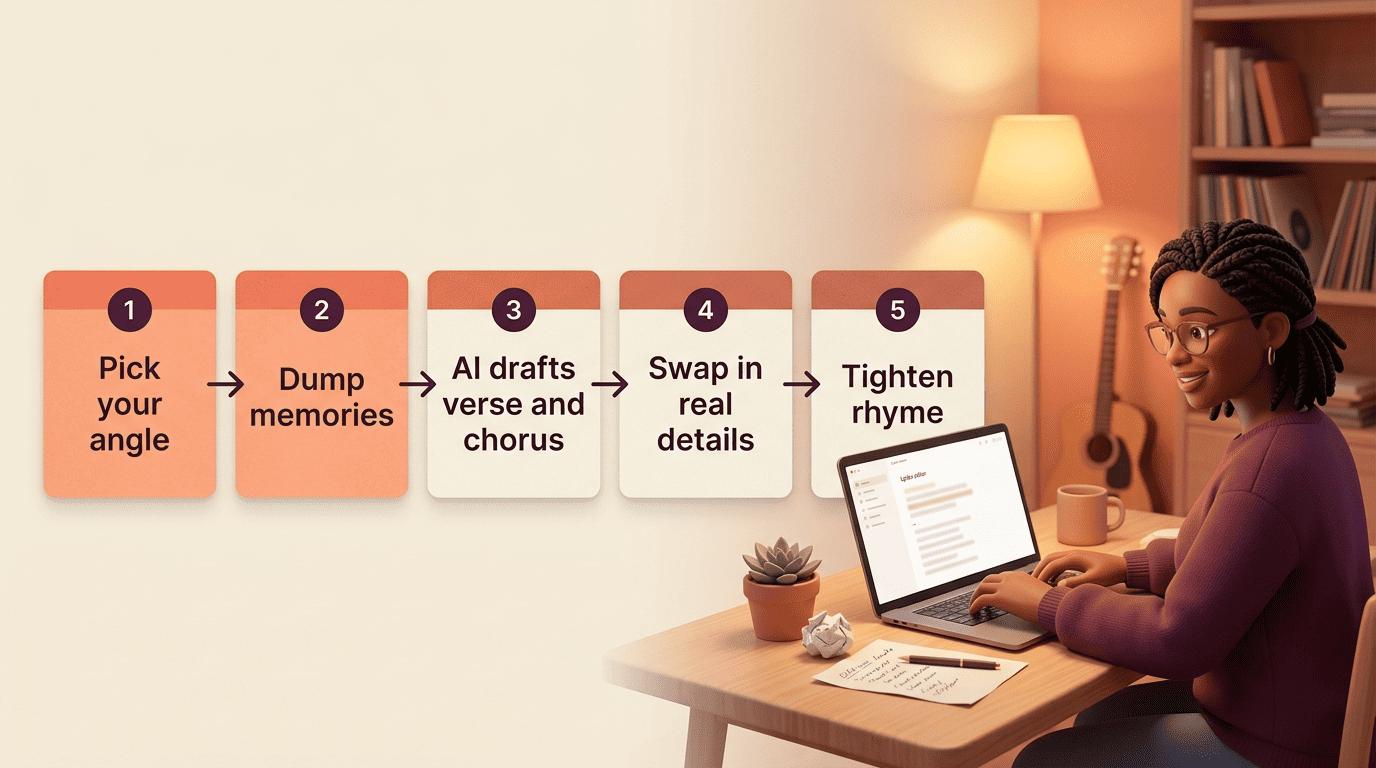
- Pick your angle from the six types above (admiration, plea, comfort, celebration, longing, heartbreak)
- Dump every specific memory, object, and inside joke you can think of — don’t edit yet
- Ask the AI to draft a verse and chorus from those details
- Swap in the real names, places, and phrases the draft left generic
- Tighten the rhyme and meter until every line reads naturally out loud
Love Songs for Weddings, Anniversaries, and Proposals
A personalized love song is one of the most memorable gifts for a first dance, an anniversary, or a proposal. Anchor it in your shared history — the date you met, the road trip, the nickname — so it could only be about the two of you. For these occasions, the celebration and admiration angles from the table above tend to work best, since the song needs to land clearly on a single listen in a room full of people.
Keep It Original: A Quick Note on Lyrics and Copyright
AI is a starting point, not a source to copy. Use it to spark original lyrics — never to lift lines from existing songs. In the U.S., original song lyrics are protected by copyright the moment they’re written down; the U.S. Copyright Office treats lyrics as a literary work you can register.
Love songs need to feel intimate. The most intimacy you can create lives in direct address (I, you) and present tense.
Pat Pattison, Berklee College of Music songwriting faculty
Keep your song yours: write from your own memory, let an AI draft help you get unstuck, and always run the final lyrics back through your own voice before you call the song finished.